
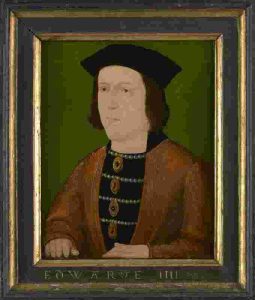
King Edward IV was born to Richard 3rd Duke of York and Cecily Neville on 28 March 1442 in Rouen, Normandy. He was proclaimed King by his supporters on 4 March 1461, securing the seizure of power with victory at Towton later the same month. He ruled until October 1470. Following the readeption of Henry VI he was restored to crown in April 1471, reigning until his death in April 1483. Edward IV married Elizabeth Woodville in 1464. The couple had ten children, seven of whom survived Edward.
Childhood of Edward of Rouen
Edward and his younger brother Edmund were born in Rouen, Normandy. This was whilst his father, Richard 3rd Duke of York, held senior command of English possessions in France. Edward was raised within the Duke of York’s household, often based at Ludlow.
Edward Earl of March 1459-1460
The political clashes that Edward’s father had been involved in throughout the 1450’s erupted into warfare in 1459. It thrust the young Earl of March into a military setting and made him a person of national political importance.
Ludford Bridge
The Yorkist decision to bring together their forces at Ludlow in 1459 saw the Earl of Salisbury engaged in the Battle of Blore Heath. Then, at Ludford Bridge, the Yorkist affinity was faced with a full Royal Army. Following the defection of the Calais Garrison, the Yorkist Lords, including Edward Earl of March, chose to take flight for their own safety.
Edward in Calais
As a result of the rout at Ludford, Edward Earl of March took refuge with the Earls of Salisbury and Warwick in Calais. It is possible that, on St. George’s Day 1460, Edward participated in the Battle of Newnham Bridge, a failed Lancastrian attempt to force entry into Calais.
Battle of Northampton
In June 1460, the Yorkist force based in Calais sailed to England. After landing at Sandwich, the Yorkists left the Earl of Salisbury to take charge of the Siege of the Tower of London, whilst Edward Earl of March and the Earl of Warwick marched north. At Northampton, on 10 July 1460, they defeated a royal army.
Act of Accord places Edward 2nd in line to the Crown
Richard 3rd Duke of York’s return changed the approach of the Yorkist faction. Now, the Duke of York stated that, by Right, the Crown was his. This shocked many nobles, leading to a debate about how to deal with the unprecedented scenario. The result was a compromise Act of Accord. This placed Richard 3rd Duke of York as next in line to the throne. His son, Edward Earl of March, would in turn inherit from him.
Preparation for War
The Act of Accord was unacceptable to Queen Margaret and the Lancastrian faction. They began preparing for war.
Edward Earl of March had seen his fortunes change dramatically. From fleeing into exile and potentially left with little, he had become second in line to the throne of England. It was clear that this newly acquired position would be challenged. Edward went to the estates of his father around Ludlow and the Welsh Marches to ready their retinue for war.
Edward’s father killed near Wakefield
Whilst Edward was making arrangements in the West of England, his father, his brother Edmund, and the Earl of Salisbury headed north to address the unruly actions of their foes. The Duke of York’s journey north proved to be disastrous for the Yorkists. The Duke and the Earls of Rutland and Salisbury were all killed.
Note: Traditionally the deaths of the Duke of York and Earls of Rutland and Salisbury is held to have happened as a result of the Battle of Wakefield, outside Sandal Castle. Recent research by P Dawson and D Grummitt shows that the trio of Yorkist lords were killed in different circumstances, with the date(s), location(s) and people involved differing from popularised non contemporary accounts.
Becoming King Edward IV
When word of his fathers death reached Edward, he was already raising his forces in the Welsh Marches. It was clear that the Lancastrians would now try and follow up their success in Yorkshire. London was already held by the Earl of Warwick. It would inevitably be challenged by Lancastrian forces. Edward was faced with a threat in his own vicinity. A force of Lancastrian loyalists sought to make their way towards Queen Margaret. That force, led by Owen Tudor, Jasper Tudor, and James Butler Earl of Wiltshire, would need to travel through the Yorkist lands that Edward was recruiting in.
Edward victorious at Mortimer’s Cross
Edward blocked the Lancastrian advance in the Battle of Mortimer’s Cross. This battle was Edward’s first command in battle [he may have fought at Newnham Bridge]. Edward led his men to victory. The defeat of the Lancastrians saw Owen Tudor captured, and executed. Edward then made his way to meet with the Earl of Warwick.
Proclamation as King Edward IV
Having joined with Richard Neville Earl of Warwick, the pair made their way to London. The Earl of Warwick had just engaged the Lancastrians in the Second Battle of St. Albans and lost, also leaving King Henry VI behind. Yorkist strategy now focussed on ensuring control of London and halting the Lancastrian threat. Alongside this military objective, on 4 March 1461, the Yorkists also proclaimed Edward to be King of England.
Arguing that the Lancastrians had broken the Act of Accord, the 18 year old Edward was said to be rightful King of England. It may have been a tenuous argument, but it was welcomed in London. This provided Edward IV with a platform from which he and his allies could try to secure the throne.
First Reign of King Edward IV
As Edward was being proclaimed King of England in London by the Yorkists, their foe was retreating to the north. Despite their victory at St. Albans, the Queen and her commanders opted to not force entry into London. It gave the Yorkists an opportunity to regroup and plan their next move.
Edward IV prepares to secure his Crown
Edward IV and the Earl of Warwick were aware that their foe could potentially draw upon more forces and perhaps call upon allies in the form of Scotland, or France. To secure the Crown, the Yorkists needed to force a decisive victory. And fast. Senior Yorkist nobles therefore began arraying their forces. Calls to arms were issued. Preparations were made for a rapid counter offensive.
Towton
By mid March the Yorkists had amassed a large enough force to begin their advance. Edward IV and his allies marched north. The outcome was a series of clashes in the West Riding of Yorkshire. At Ferrybridge, Dintingdale, and Towton the Yorkists defeated the Lancastrians and King Henry VI, Queen Margaret and their surviving supporters took flight:
our sovereign lord [King Edward IV] has won the field and, on the Monday next after Palm Sunday, he was received into York with great solemnity and processions…
… King Harry, the Queen, the Prince, the Dukes of Somerset and Exeter, Lord Roos, been fled into Scotland, and thy be chased and followed.
Paston Letters. [4 April 1461, W Playnter to John Paston]
Consolidation
The victory of late March 1461 did not eliminate a threat to King Edward IV’s reign. Though the Lancastrians had been defeated, the King, Queen and Prince of Wales had escaped. Many of their supporters also survived the clashes. Edward’s priorities now were to eradicate the pockets of Lancastrian resistance: which were mainly in the north and in Wales. He also needed to establish a Yorkist government. And, he had to persuade people across the country of his legitimacy as King.
Marriage of Edward IV and Elizabeth Woodville
In 1464, Edward IV married Elizabeth Woodville. The marriage took place in secret. Elizabeth was daughter of Richard Woodville and Jaquetta Duchess of Bedford. Though her mother held high status, her father did not. This made the union one that was seen as being unsuitable for the King in the eyes of some courtiers.
Woodville Family
After Edward notified his Council of the marriage, members of the Queen’s family began to receive royal favour. Whilst this is to be expected, it frustrated some senior nobles who saw their longstanding, inherited rights and positions being challenged by newly promoted members of the Woodville family.
Disillusion of the Duke of Clarence and Earl of Warwick
Additional problems stemmed from these arrangements. The counsel that the old guard gave King Edward IV about key matters was often at odds with the counsel being given by newer members of his court. Foreign policy, in particular, saw a divergence of views. As the influence of the Queen’s kin grew, men such as the King’s brother, George Duke of Clarence, and his cousin, Richard Neville Earl of Warwick, grew increasingly frustrated.

1469/70 Revolts against King Edward IV
In 1469 the Duke of Clarence and Earl of Warwick’s frustration at their perceived lack of respect or authority in Court resulted in revolt.
The pair coordinated a revolt to take place in the north of England. It coincided with the Duke of Clarence marrying Isabel Neville, a daughter of the Earl, against the King’s wishes. As Edward marched north to address the revolt, the Duke and Earl issued proclamations. After the Battle of Edgcote, Edward found himself taken into the ‘care’ of his kin. He was sent to Middleham Castle and the Duke and Earl attempted to rule in his stead.
Edward IV: Return to power, Further Revolts
Edward IV did not remain in the custody of his cousin and brother for long. England was in turmoil, and the Duke and Earl were unable to govern effectively in his absence. For a time, they worked with Edward. The unease did not go away though. In 1470, another revolt was orchestrated by the Duke and Earl. This time, Edward IV was able to overcome the threat. It resulted in the Battle of Losecote Field, a victory for Edward IV. The Duke of Clarence and Earl of Warwick fled to France.
Edward IV in exile
Victory at Losecote Field for Edward IV was far from the end of his woes. In France, the signing of the Angers Agreement saw the Earl of Warwick and Duke of Clarence ally with Queen Margaret. When they then returned to England, Edward IV and his closest supporters were forced to flee, to the Low Countries.
As a consequence of Edward’s flight to the Low Countries and union of the Lancastrians with the Earl of Warwick and Duke of Clarence, King Henry VI was reinstated. The Readeption of King Henry VI was to last from 3 October 1470 until 11 April 1471.
1471 – Edward IV’s campaign to retake the Crown
The Readeption of King Henry VI soon led to a change in English foreign policy. Aid was promised to France, against Burgundy. The Duke of Burgundy now had good reason to help Edward IV. The outcome was a fleet being provided for Edward and his supporters to sail to England.
‘Arrivall’ The Campaign to retake the Crown
On 12 March 1471 Edward IV landed on the Yorkshire coast. Edward led his force inland. At York he was initially refused entry, before being admitted on the basis on him being the Duke of York. He then moved south, gathering supporters as he did, whilst also being shadowed by forces loyal to the Readeption government.
George Duke of Clarence returns to Edward IV’s side
Negotiations with his estranged brother, George Duke of Clarence came to fruition. The Duke returned to his brothers side on the march from York to London. Emboldened by the growth in his ranks, Edward IV challenged the Earl of Warwick to negotiate, or fight. The Earl chose to remain behind the barricades of Coventry, awaiting additional forces before engaging Edward.
Edward IV regains control of London, April 1471
As forces of both sides sought to gather large enough forces to secure an overwhelming victory, Edward led his men from the midlands to London. He was able to enter the City of London unopposed. King Henry VI was soon in his possession. The Earl of Warwick and his brother John Neville Marquess of Montagu were soon joined by Lancastrian magnates and their retinues. When they marched on London, Edward set out to face them.
Battle of Barnet
The Battle of Barnet on 11 April 1471 saw the forces of Edward IV, defeat an army of the coalition of Lancastrians and Earl of Warwick. Both the Earl of Warwick and Marquess of Montagu died at Barnet. Lancastrians such as the Duke of Exeter and Earl of Oxford were able to escape the rout that followed Edward’s victory.
Most historians note the victory at Barnet as being the beginning of Edward IV’s second reign. It was far from secure at this stage, though. Shortly after the Battle of Barnet, Queen Margaret and a Lancastrian army landed in the South West. They recruited as they moved towards Wales. If the Queen and Prince Edward [of Westminster] were able to join forces with Jasper Tudor in Wales, they would have a considerable army.
Battle of Tewkesbury
Edward IV set out to block the Queen and Duke of Somerset’s army. At Tewkesbury, he was able to prevent it from making a river crossing. Instead, the Lancastrians were forced to fight a battle. The Battle of Tewkesbury was a decisive Yorkist victory. Prince Edward was killed. Senior Lancastrian magnates were forced to take refuge in Tewkesbury Abbey as their army was defeated. It did not save them, they were removed from the Abbey – where they claimed Sanctuary – and executed after short trials.
Siege of London
As the Yorkists won a major victory at Tewkesbury, London came under threat. Thomas Neville the bastard of Fauconberg sailed a force up the Thames. A Siege of London took place from 10 -14 May 1471. The return of Yorkist forces from the south west brought an end to the Siege.
The restoration of Edward IV was complete just a week later. On 21 May 1471, King Henry VI died in the Tower of London. Officially, he died of melancholy. More probably, he was killed.
The Second Reign of King Edward IV
Edward IV’s second reign was one of relative peace in England. It is most noted for:
- Disputes between the Dukes of Clarence and Gloucester over the Neville inheritance
- Addressing Lancastrian resistance and potential future threats to Yorkist rule
- Arrest, Trial, and Execution of George Duke of Clarence
- Foreign Affairs. In particular, an Invasion of Frane in 1475 and an Invasion of Scotland in 1482.
Edward IV and the problem of the Neville Inheritance
In his second reign, Edward IV saw his brothers bicker over the redistribution of lands formerly held by the late Earl of Warwick. This matter was complicated [see here]. From 1471 to 1475 the brothers of the King sought to extend their personal domains through aquisition of Neville estates. It led to some thinking that the pair may come to blows over the matter. It was eventually settled by King Edward IV via parliament, with settlements being made in 1474 and 1475 that divided the Neville and Beauchamp estates between the Dukes.
Lancastrian opposition during Edward IV’s second reign
Though most Lancastrian opposition had been eliminated in 1471, there were some threats to Edward’s reign. The Earl of Oxford raided across the Channel, then seized St. Michael’s Mount, leading to a siege lasting some 23 weeks. Edward IV was also alert to potential claims being made via extended members of the Lancastrian line. This included diplomatic efforts to bring Henry Tudor back to England from his self imposed exile.
Lancastrian, Henry Holland, Duke of Exeter had survived the Battle of Barnet. Having been held in custody, he was eventually freed and allowed access to court. The Duke had been married to Anne of York, a sister of the King. That marriage was annulled, and as the English army returned from France in 1475, the Duke ‘fell’ overboard.
Execution of the King’s Brother
In 1478, George Duke of Clarence was arrested, tried, and executed on charges of treason. Famously, he is said to have been executed by drowning in Malmsey Wine. George’s indiscretions are discussed in depth here. His trial and fate was a major distraction from diplomatic efforts being undertaken at the time. And took place alongside the marriage of the King’s second eldest son, Richard of Shrewsbury, to Anne Mowbray.
Edward IV: Invasions of France and Scotland
Despite the above, England was secure enough for Edward IV to be more assertive in Foreign affairs. In 1475 he led a campaign into France. This invasion of France was a large undertaking. It resulted in an agreement of terms being made, in England’s favour, via the Treaty of Picquigny. In 1482 Edward IV chose to intervene in Scottish affairs. He appointed his brother, Richard Duke of Gloucester, to command a force. The Invasion of Scotland was also quite short-lived. The Scottish parties reached agreements as the English arrived outside Edinburgh Castle. Notably, the campaign resulted in England regaining possession of Berwick-upon-Tweed, following a successful siege.
Death of King Edward IV
Edward IV died on 9 April 1483. His death was unexpected. The cause of Edward’s death has been speculated about, with a recent study suggesting that he may have died of Syphillis. Edward had planned for his burial. He chose to be buried within the chapel at Windsor Castle. The chapel had been upgraded by Edward during his second reign. He became the first monarch to be buried at Windsor, being entombed there on 19 April 1483 following a funeral service at Westminster held on 17 April.
Featured Content on King Edward IV
Edward IV’s entry into York following the Battle of Towton
Coronation, from the Croyland Chronicle
The Edward Poster: Typological life and genealogy of Edward IV
Edward in Bristol prior to campaign to secure Wales
Marriage to Elizabeth Woodville, from the Croyland Chronicle
Was the Emergence of the Middle Classes a result of King Edward IV’s policies?
Accumulation of Wealth, from the Croyland Chronicle
Edward IV’s letter to Sir John Paston, 1468
Claim to the French Crown, 1472
Landing at Ravenspur, from the Croyland Chronicle
Edward IV’s vision at Daventry
Invasion of France and the treaty of Picquigny, 1475
Death of Edward IV from the Croyland Chronicle
Funeral of Edward IV, from the Croyland Chronicle
Education Resources on King Edward IV
How did Edward IV gain the crown in 1461? A-Level History. Series of activities that explore the options available to the Lancastrians and Yorkists from the Battle of Wakefield to the Yorkist Victory at Towton.
Edward IV and his marriage to Elizabeth Woodville. Detailed series of activities/ discussion points exploring the nature of the marriage, its impact on diplomacy and society, and contemporary views of the union.
Image Credits
Featured Image: King Edward IV by Unknown artist. Oil on panel, 1597-1618. NPG 4980(10) © National Portrait Gallery, London. Available via a Creative Commons Licence.
King Edward IV by Unknown English artist. Oil on panel, circa 1540. 13 in. x 10 3/4 in. (330 mm x 273 mm) NPG 3542 © National Portrait Gallery, London. Available via a Creative Commons Licence.
Parhelion, the Three Suns at the Battle of Mortimer’s Cross. Source: Fig. 3. London, British Library, Harley MS 7353 f 1r, detail prophesy of Edward IV. © British Library Board” before shelfmark “Harley MS”. File from The Kings’ Lines and Lies: Genealogical Rolls in Mythmaking and Political Rhetoric in the Reign of Henry VII – Scientific Figure on ResearchGate.
Pingback: Sir James Tyrell – The Wars of the Roses