King Henry VII [Henry Tudor] (28 January 1457 – 21 April 1509] was born at Pembroke Castle, Wales. His mother was Lady Margaret Beaufort, his father Edmund Tudor Earl of Richmond. Henry’s mothers lineage made him an unlikely candidate to be King in the event of a succession crisis. As such, his care as a child was controlled by the Crown with visits from his mother. Henry went into exile in 1471 as he was a potential Lancastrian claimant to the Crown following the deaths of Henry VI and Prince Edward [of Westminster]. He later staked that claim, invading in 1485 and defeating King Richard III at Bosworth to become King Henry VII.
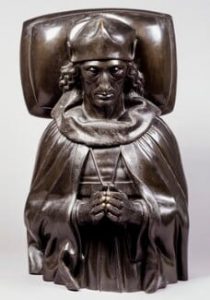
electrotype, 1870, based on a work of circa 1512-1519. National Portrait Gallery: NPG 290
Childhood of Henry Tudor
Henry Tudor was born after the death of his father, Edmund Tudor. His mother, Margaret Beaufort, was young, aged 13. The newborn Henry was of importance. Through his mother, he was a descendant of Edward III and John of Gaunt. His father had been a half-brother of King Henry VI. As a child of such notable birth, his welfare was a matter of interest for the Crown.
In the first instance, the care of Henry Tudor was overseen by his paternal uncle, Jasper Tudor Earl of Pembroke. Jasper took Henry into his household, and made arrangements for Lady Margaret to remarry. This was intended to protect mother and child. However, the events of 1459-61 were to bring an end to the arrangement for Henry’s care.
Following the Yorkist victories of 1461, Jasper Tudor was forced into hiding, then exile. Henry Tudor was still considered important by the Crown though, he was, afterall, related to the Yorkists as well as the Lancastrians. King Edward IV granted the wardship [care] of Henry Tudor to William Herbert, who had been installed as Jasper’s replacement as Earl of Pembroke. Under his care, Lady Margaret was able to visit her son, who was raised as a noble child within Herbert’s household.
Henry Tudor in exile
The resumption of hostilities in the period 1469-71 presented complications for the care of Henry Tudor. His mother sought to assert claims to titles and lands which he had a claim to by right of his father. The Crown changing hands from Edward IV to Henry VI in 1470 presented hope of Henry being granted his fathers Earldom. Edward IV’s return, and victory, in 1471, altered everything though.
The conflicts of 1469-71 saw the death of William Herbert. It also brought about an end to any hopes of Henry being restored to his fathers lands. Furthermore, the death in battle of Edward of Westminster, and of King Henry VI in the Tower of London, meant that Henry’s lineage was of much greater political interest. With the line of Henry VI dead, the Lancastrian claim, as weak as it was following 1471, lay largely in the hands of Henry Tudor via his mother’s lineage.
Henry was now a potential threat to the Yorkist regime. Should there be a Lancastrian revival, he was one of the few who could point to any kind of ‘right’ to the crown. Though this was an unlikely prospect in 1471, the potential of Henry being perceived as a threat was great enough for him to be taken into exile by his uncle, Jasper, with his mothers blessing.
Henry Tudor landed in Brittany, where he was able to stay at the Duke’s court. Diplomatic overtures between the Yorkist regime and Duke of Brittany took place regarding Henry through Edward IV’s second reign. He was able to correspond with his mother. Whilst he was a potential threat, Henry was also a potential asset to the Yorkist regime.
1483 – 1485: Eyes on the Crown
The death of Edward IV in April 1483 brought about a succession crisis in England. His son, Edward V, was never crowned. Instead, in June 1483 he was declared illegitimate and Richard duke of Gloucester became King Richard III. It was a period of turmoil, with senior nobles being executed and many members of Edward IV’s household, or tied to the Queen’s family, losing rank or becoming disillusioned.
In Autumn of 1483 this resulted in a series of coordinated revolts against King Richard III. Commonly known as the Buckingham Rebellion, it saw a failed attempt to oust Richard. Henry Tudor was involved in the revolt, having sailed into the channel and attempted to land in support of the rebels.
Henry Tudor did land though. He was alerted to the failure of the revolt and sailed away to avoid capture. The die was now cast though. Henry Tudor, with his mother being heavily implicated, had taken arms against the new King. There was little chance of rapproachment and given the summary executions of nobles in England in 1483, little hope of safe return to England. With the execution of the Duke of Buckingham as a result of the revolt, Henry Tudor also became the most viable alternative to the new King.
Becoming King Henry VII: The Invasion of 1485
Those fleeing the turmoil of 1483 had one thing in common: they opposed Richard III. It created an unusual mixture of exiled Lancastrians, disgruntled Yorkists, and fearful members of the Woodville family. With the involvement of Lady Margaret Beaufort and Dowager Queen Elizabeth Woodville, they began planning to oust Richard III and place Henry Tudor on the throne.
King Henry VII and the end of the Wars of the Roses
On 1 August 1485 Henry Tudor sailed from France at the head of an army. His fleet landed at Milford Haven in Wales, then marched north. After recruiting further men for his force, his army made its way into England. At Bosworth, he was met by the army of King Richard III. Against the odds, Henry Tudor’s army was victorious, ending the life of King Richard and taking the Crown by right of conquest.
The victory at Bosworth on 22 August 1485 did not bring an end to the Wars of the Roses. Henry fulfilled an agreement made by his mother and Elizabeth Woodville and married Elizabeth of York. This intended to unite the two warring branches of the Plantagenet family. This on its own was not enough to bring warfare to an end. There were still Yorkist claimants. In 1487 an invasion took place which intended to oust Henry VII and replace him with a pretender, Lambert Simnel, who was said to be Edward Earl of Warwick, the son of George Duke of Clarence.
That invasion failed, with a Royal Army defeating the Yorkists in the Battle of Stoke Field on 16 June 1487. Further claimants to the crown later took up arms. The most dangerous of which was those of Perkin Warbeck. Warbeck is commonly known as being a pretender, though there is evidence to suggest that he may have been Richard of Shrewsbury. Whether he was the ‘Prince in the Tower’ or a Pretender, his attempts also failed. Warbeck/ Richard of Shrewsbury was captured and imprisoned. In 1499 he and the [actual] Edward Earl of Warwick were executed for conspiracy from within their gaol at the Tower of London.
Even with the failure of Simnel and Warbeck’s invasions, there remained a threat to King Henry VII’s hold on the crown. The last Yorkist Claimant to make a case for his right to be king was Richard de la Pole. Richard was a son of John de la Pole 2nd Duke of Suffolk and Elizabeth of York, a sister of King’s Edward IV and Richard III. He maintained his claim until his death in 1525 and had supporters on the continent who, at times, appeared willing to support his cause with finance and arms.

Books about King Henry VII
Amin, Nathen. Son of Prophecy: The Rise of Henry Tudor
Amin, Nathen. Henry VII and the Tudor Pretenders: Simnel, Warbeck, and Warwick
Chrimes, S. B. Henry VII (The English Monarchs Series)
Turvey, Roger and Rogers, Caroline. Access to History: Henry VII third edition
Henry Tudor Links
British Museum – Over 2000 items relating to King Henry VII can be accessed via the museum’s website.
National Portrait Gallery – 68 portraits of or including King Henry VII
Oxford Dictionary of National Biography – Henry VII, King of England and lord of Ireland
Royal Museums Greenwich – King Henry VII: Where was he born and how did he die?
Westminster Abbey -Henry VII and Elizabeth of York
Featured Image
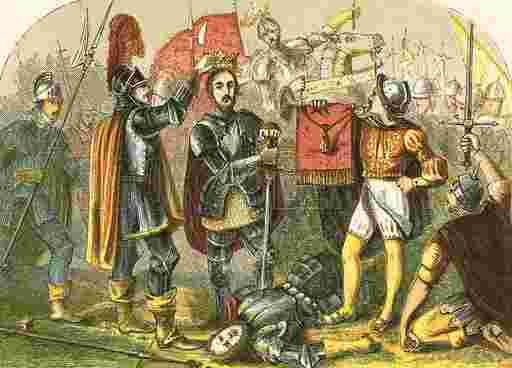
Henry Tudor being crowned King of England following his victory in the Battle of Bosworth.
From: A History of England for the Young. Author: Tyrrell, Henry / London; New York: London Printing & Publishing Co, [1872, 73]. Public Domain.
Pingback: Lambert Simnel – The Wars of the Roses