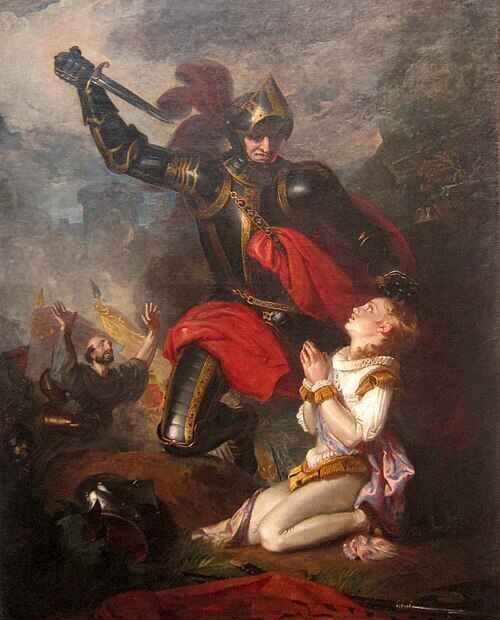
Edmund Earl of Rutland was the second eldest son of Richard 3rd Duke of York and Cecily Neville Duchess of York. Born in Rouen on 17 May 1443, Edmund was created Earl of Rutland by King Henry VI no later than June 1454. He held rank as Lord Chancellor of Ireland but is most commonly remembered for the legend surrounding his death aged 17 in 1460.
Edmund Plantagenet’s Upbringing
Edmund was born in Rouen, Normandy, whilst his father was Lieutenant of France. In 1445 the Duke was recalled to England and based himself, with his family and household, at Ludlow in the heart of his estates. When Richard was appointed as Lieutenant of Ireland in 1447, the family moved to Dublin with him. The family remained their until 1450, when they returned to Ludlow.
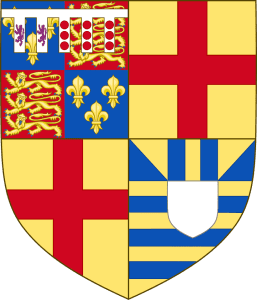
Appointment of Edmund of York as Chancellor of Ireland
Though Richard Duke of York had returned to England, he remained the Lieutenant of Ireland. In 1451, in his capacity as Lieutenant he appointed Edmund as the Chancellor of Ireland. At the time, Edmund was 8 years old. The role was therefore performed on Edmund’s behalf by deputies. The decision to appoint Edmund to this position was political. Whilst it had the potential to provide the young edmund with administrative experience and status as he grew older, the politics of the day made control of the position of note.
Governance in Ireland at this time was disputed. The Irish Parliament was asserting it’s independence. Rivalries between the great Irish families were heated. Control of lawmaking, governance, and adminstrative structures was largely vested in one position: the Lord Chancellor of Ireland. By appointing his second eldest son, albeit an 8 year old, Richard was shoring up his grip on Ireland as Lieutenant. This also enabled the Duke of York to provide patronage via his sons deputies to his supporters in Ireland: which would prove useful over the course of the 1450’s and into the Wars of the Roses for the House of York.
Creation of Edmund Earl of Rutland
It is not known exactly when Edmund was created Earl of Rutland. The title was used in documents dating to 1454. At this time King Henry VI had been promoting members of his extended family, essentially making up for the lack of close family around the throne. Edmund’s creation as Earl of Rutland, a title which was derived from Edmund 2nd Duke of York, Edmund’s great-uncle, who had held the title from 1390. The decision may have simply reflected Edmund’s status as a son of the Duke of York. Equally, it may have been created for him as part of the political bargaining of the period.
Edmund at Ludlow
Edmund shared a household with his elder brother, the future Edward IV, at Ludlow during the 1450’s. This was an unusual arrangement but meant that the boys could have a stable upbringing whilst their father was either posted overseas, at court, involved in disputes, or acting as Protector. It was at Ludlow that Edmund saw the militarisation of politics first hand, in 1459.
Ludford Bridge and exile in Ireland
In 1459 the Yorkist Lords merged their forces, meeting at Ludlow. They were challenged by a Royal Army. Edmund Earl of Rutland was within Ludlow Castle as the standoff across the River Teme took place. When men from the Calais Garrison defected from the Earl of Warwick‘s force to the Royal Army, the Yorkist Lords fled. The Rout at Ludford Bridge saw Edmund Earl of Rutland join his father in flight, to Ireland.
1460. Return to England
Edmund returned to England at his father’s side in 1460. He was witness to the political turbulence that surrounded the Duke’s claiming of the Crown. Edmund Earl of Rutland was now old enough to join with armies, and as the Lancastrian response to the Act of Accord turned violent, he joined with his father and uncle, Richard Earl of Salisbury, at the head of a force intending to quash the disturbances that their political foes were enacting in the north.
Edmund Earl of Rutland’s death in the Battle of Wakefield
Edmund is best remembered in history not for his acts as an Earl but for the manner in which he died. His end was met at the hands of Lancastrians near Wakefield at the end of December 1460.
Typically, the death of Earl of Rutland is retold based on the account of Edward Hall, Raphael Holinshed, or the dramatisation of his death in Shakespeare’s play King Henry VI, Part III. However, these sources are at odds with most of the accounts that were written prior to their publication. And those earlier accounts do not agree on the facts surrounding the Earl’s fate.
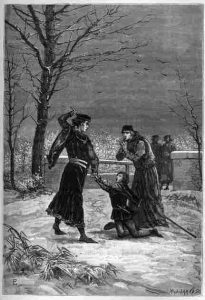
Written in the 16th century, Hall’s account inaccurately suggests that Edmund was aged twelve. It further says that he was slain whilst kneeling, imploring mercy, by Lord Clifford. In Shakespeare’s dramatisation, which is based on Holinshed, Lord Clifford slays the helpless Earl of Rutland as an act of revenge for the Yorkists having killed his father in 1455.
The popularity of these sources, despite their many flaws, has created a legend around the fate of Edmund Earl of Rutland that persists and is often simply accepted. Other sources suggest that the Earl was taken prisoner then murdered, or killed whilst in flight. For the latter suggestion, there is nothing in chronicles besides Hall’s fanciful account which suggests that he was killed in cold blood on Wakefield Bridge.
In reality, we have little to confirm exactly how, where, or when Edmund was killed. We do know that his body was first laid to rest in Pontefract: later moved to Fotheringay during the second reign of Edward IV.
For a recent appraisal of the realities of the events at the Battle of Wakefield see Paul L Dawson and David Grummitt’s research into the ‘battle’.
Links: Edmund Earl of Rutland
History of Parliament – John, Lord Clifford, ‘the butcher’ and the killing of Edmund, earl of Rutland, at the battle of Wakefield, 30 December 1460
Research
2025. Paul L Dawson and David Grummitt have published findings on the Battle of Wakefield which reassess the circumstances in which the Earl of Rutland, his father, and uncle, were slain. Using contemporary evidence their findings suggest that much of what is commonly believed about the Earl of Rutland’s demise is no more than myth and the [inaccurate] impact of dramatisations.