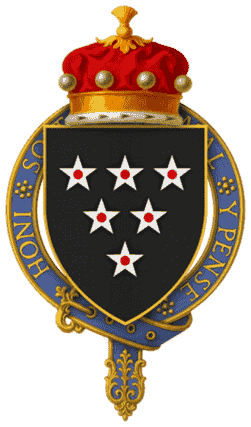
William Bonville 1st Baron Bonville was born in Shute, Devon, in 1392. Lord Bonville is best known for his part in the Courtnay – Bonville feud. Prior to this, he had served with distinction in campaigns in France, including in the Agincourt Campaign. A wealthy member of the gentry, William Bonville benefitted from land acquisitions made by his father and grandfather, and sought to further expand the families influence. A supporter of the House of York, William Bonville was executed shortly after the second battle of St. Albans in February 1461. He had been predeceased by his son, also called William Bonville, and the male line of the Bonville family was extinct as a result.
Family background of William Bonville
William Bonville was born at Shute Manor c1392. His father, John Bonville, died in 1396. Subsequently, William was raised in the household of his grandfather, also named William Bonville. His grandfather was a landholder in the South-West, who held at least 18 manors and was called to Parliament representing Devon or Somerset a total of 17 times. William’s grandfather was also a liveried retainer of Edward Courtenay, Earl of Devon. These led to numerous appointments to local positions and a considerable income, of around £900 per annum.
Following his grandfathers death, in 1408, William was made a ward of Edward 2nd Duke of York. He gained livery in 1413 and took legal action to take possession of his late mothers dower as she had granted it to her second husband.
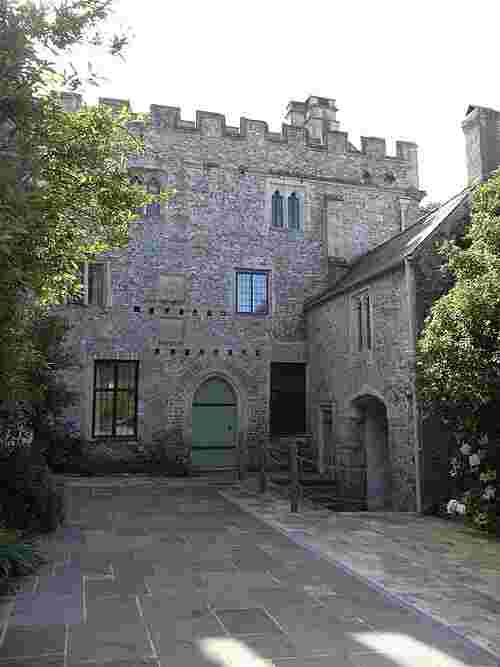
Public Domain, via Wikimedia.
Estates and Regional Influence of William Bonville
William Bonville held lands in several parts of the country. Most of these were concentrated in the south west, with particular influence on south-east Devon and in central Somerset. His grandfathers positions and influence gave William a solid basis upon which to build his own reputation.
Early career: Military and Administrative
Shortly after comining of age and being granted livery of his estates he contracted to marry [December 1414]. He was then involved in the military campaigns of King Henry V in France. William Bonville was part of the retinue of Thomas Duke of Clarence in the 1415 Campaign, taking part in the Battle of Agincourt. The next few years saw him serve in France and Normandy which appears to have taken up the bulk of his time until 1421.
In 1421, William Bonville was present at Parliament which he again attended in 1422. From 1423, he was more active in politics and administrative duties than military matters. William was appointed Sheriff of Devon in 1423. He then began to make efforts to increase his influence and landholdings, particularly in the south west. These led to some violent clashes, with William being subject of a commission of oyer and terminer in 1427 that investigated his use of force in a dispute over enclosure of lands in Weycroft and Axmouth.
William Bonville enhanced his families standing through marriages. This formed an affinity with Lord Harington, and saw two of his daughters marry members of the Courtenay family. The latter marriages formed an allegiance with a cadet branch of the Courtenays, those based at Powderham, which would be of consequence later in William’s life. William himself had married a Courtenay, his second wife [m. 1427] being an aunt of the Earl of Devon.
1437: Appointment as Royal Steward of Cornwall and the beginning of the Courtenay – Bonville Feud
In 1437 William Bonville was appointed as Steward of Cornwall. This role had usually been taken by the Earls of Devon. It came at a time when Thomas Courtenay 13th Earl of Devon was holder of the regional title. Thomas was young, and had a limited inheritance. Furthermore, his families influence had been reduced over the previous decade by the rise of families such as the Bonville’s. Thomas took the appointment of William Bonville as a slight and it led to an alarming increase in violence between the two mens supporters in the period to 1440. This was inadvertently heightened by governmental attempts to mitigate the grievance of the Earl of Devon. He was appointed as Steward of the Duchy of Cornwall. [The two roles are different but have significant overlap as the rights of the Duchy and County are inextricably linked].
William Bonville in France: 1443 – 1444
One way in which the authorities tried to reduce tensions in the south west was to appoint William Bonville to the position of seneschal of Gascony. The appointment was made late in 1442, with William sailing in March of 1443. He remained in Gascony for roughly two years. During this time William grew closer politically to the Duke of Suffolk, and his political foe the Earl of Devon was largely held in check by Council who appear to have attributed fault more on the Earl than upon Bonville.
Elevation to the Peerage as Baron Bonville in 1449
The 1440’s saw William Bonville develop close bonds to important individuals at Court. Through his time serving in Gascony, he maintained and developed ties to the Duke of Suffolk. This was such that William was invited to be one of the men who attended Margaret of Anjou‘s bethrothal ceremonies in 1444.
He furthered his ties to the affinity of the Duke of Suffolk through arranging the marriage of his daughter Elizabeth to Sir William Tailboys, one of the Duke’s principle retainers and henchmen. This and William’s increased influence over affairs in the south west saw him grow close to the clique that was running Council. As a result, in 1449, William was elevate to the rank of Baron via invite to Parliament as William 1st Baron Bonville.
Siege of Taunton Castle
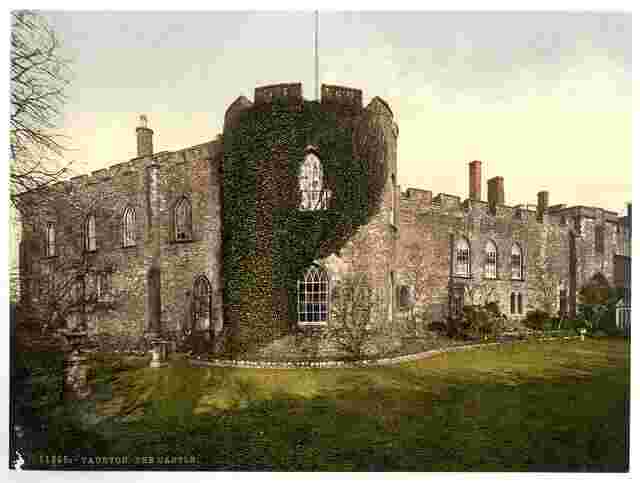
Photochrome print postcard. Title from the Detroit Publishing Co., Catalogue J foreign section, Detroit, Mich. : Detroit Publishing Company, 1905. Public Domain, via Picryl.
In 1450 William de la Pole Duke of Suffolk was impeached, sent into exile, and murdered whilst making his way to the continent. The fall from grace then assassination of the Duke transformed the balance of power at Council. With it, the status of Baron Bonville and other associates of the Duke, were at risk.
Thomas Courtnenay 13th Earl of Devon was alert to this. He raised a band of men and marched on the Bonville held castle at Taunton in the summer of 1451. With William Bonville inside the castle, the Earl of Devon began a siege. This siege was lifted when the Duke of York intervened, with both Bonville and the Earl of Devon being imprisoned as a result of the violence.
It was a short imprisonment. William soon saw the opportunity to assert his influence once again. Following the humiliation of the Duke of York at Dartford in 1452, his supporters – the Earl of Devon being a primary one – were in a weaker position.
Lord Bonville was soon appointed to the Stewardship of the Duchy of Cornwall in place of the Earl. He was appointed to other key positions in the region, such as Constable for life of Exeter Castle. His preeminence in the region was also made clear through the King’s choosing to stay at Bonville’s manor of Shute whilst undertaking a royal progress of the region. For now, William Lord Bonville was once again in the ascendancy in his dispute with Thomas Courtenay.
Murder of Nicholas Radford
The fortunes of Lord Bonville and Earl of Devon once again swayed as King Henry fell ill and the Duke of York took up the position of protector. The Earl of Devon occupied Exeter to deny Lord Bonville the means to undertake his role as collector of King’s loans. Bonville’s tenants were harassed, often violently. As national politics grew more fraught, Council was ill equipped to tackle unrest. The First Battle of St. Albans changed the national picture in favour of the Yorkists and Earl of Devon’s associates, but had little obvious impact on the ongoing clashes between the Bonville and Courtenay’s.
As William Bonville strode to increase his authority, the Earl of Devon and his associates sought to halt him. In 1455, this exploded into violence once more. On 23 October 1455 a judge in the affinity of Lord Bonville was murdered by a mob led by Thomas, eldest son of the Earl of Devon. Nicholas Radford’s murder was quite staggering. He was a judge who was actively engaged in dispensing with justice at that time in cases relating to the Earl of Devon’s men undertaking acts against Lord Bonville from the Courtenay base at Tiverton. Radford was not only an advisor to Lord Bonville, but also a man appointed to a Crown position.
Powderham Castle
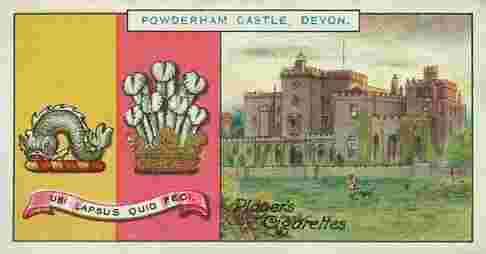
Players Cigarette Card, 1910. Public Domain.
Soon after the murder of Nicholas Radford, the Earl of Devon’s men took up arms against his relative, Sir Philip Courtenay. Sir Philip was of the cadet branch into which Lord Bonville had married one of his daughters. Sir Philip was an associate and ally. When the Earl set about laying siege to Philip’s castle at Powderham, Lord Bonville sought to intervene.
Battle of Clyst Heath
The crisis in the south west came to a head at Clyst Heath on 15 December 1455. Forces from Lord Bonville and Earl of Devon fought a small battle. It was a victory for the Earl of Devon. William Bonville’s men were forced to flee and the Earl’s men went on to ransack a number of Lord Bonville’s manors in the days that followed. Following this, there remained sporadic outbreaks of violence between men allied to the two lords.
The Wars of the Roses and Bonville’s fortunes
The increase in violence in the Courtenay – Bonville Feud coincided with the aftermath of the First Battle of St. Albans. Clyst Heath and the murder of Radford were subject to interventions by Parliament, who called, albeit unsuccessfully, for the imprionment of each of the leading figures in the dispute. Lord Bonville in the period 1455 – 1459 remained loyal to the Crown. He was appointed to Commissions in relation to administration of justice, and was outwardly loyal to King Henry and Queen Margaret as warfare broke out in 1459: he attended the Coventry Parliament, swore allegiance to the King, and was party to the attainders of the Yorkist lords. [Note that he had also attended the Yorkist parliament that followed the First Battle of St. Albans, he was not partisan in this respect].
Marriages and Land Interests
The complexities of the period led to both Lord Bonville and the Courtenay’s altering their bonds of allegiance with more senior nobles. Thomas Courtenay died in 1458, replaced as Earl of Devon by his son, also called Thomas. The Earls of Devon had become closer to the Lancastrian faction as the situation in the south west deteriorated. The new Earl of Devon married to a cousin of Margaret of Anjou and Lord Bonville’s daughter married into the Neville family. These, and shared interests in land issues, saw the two families realign their allegiances, with Lord Bonville now having more sympathy for the Yorkist cause.
Lord Bonville joins the Yorkist cause
The support of William Bonville for the Yorkists was not particularly clear, and far less so active, until the summer of 1460. At Northampton in July 1460 Lord Bonville was among the Yorkist force that defeated the Lancastrians. Then, in December 1460, his son and grandson were part of the Duke of York’s retinue which was defeated at Wakefield. Both of Lord Bonville’s male heirs were killed in the clashes near Wakefield.
William 1st Baron Bonville executed after the Second Battle of St. Albans
In early February 1461, William Lord Bonville was elected as a Knight of the Garter. It was a political decision made as the Lancastrian army advanced south. As that Lancastrian force moved closer to London, the Yorkists under the Earl of Warwick set up defences at St. Albans. There, on 17 February 1461, the Lancastrian army outwitted the Yorkists and forced the Earl of Warwick’s force to flee to London.
To hasten that retreat, the Yorkists left King Henry VI on the battlefield. He was protected by William 1st Baron Bonville and Sir Thomas Kyriel. The King had apparently promised both men that no harm would come to them should they remain at his side. Nontheless, the victorious Lancastrians had both men summarily tried, then executed, on 18 February 1461.
William Bonville 1st Baron Bonville Links
History of Parliament – William Bonville of Chewton-Mendip, Som. and Shute, Devon.
Oxford Dictionary of National Biography -Bonville, William, first Baron Bonville
The Peerage. Overview of William 1st Lord Bonville’s life, titles, and family.
Richard III and his time. Overview of William Bonville’s life.
Medieval History – the Bonville – Courtenay Dispute.
Featured Image
Coat of Arms of Willia, Bonville 1st Baron Bonville. Uploaded by Rs-nourse to Wikimedia. Public Domain. Originally sourced from Sir Bernard, The General Armory of England, Scotland, Ireland, and Wales; Comprising a Registry of Armorial Bearings from the Earliest to the Present Time, London: Harrison & Sons, 1884.
