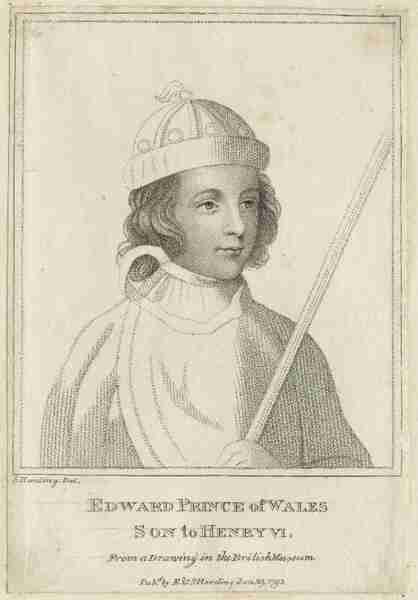
Edward of Westminster was born on 13 October 1453 in the Palace of Westminster. The only son of King Henry VI and Queen Margaret, he was Prince of Wales and heir apparent.
Edward of Westminster’s right to inherit was challenged by the Act of Accord of 1460. This led to intensified conflict and culminated in a Yorkist seizure of power. In 1470, Edward of Westminster married Anne Neville as part of the Angers Agreement. He was then one of the figureheads of the Lancastrian force that landed in support of the readeption in April 1471. Edward of Westminster died in the Battle of Tewkesbury on 4 May 1471 and was buried in Tewkesbury Abbey.
Edward of Westminster. Birth and Importance
The birth of Edward of Westminster was hugely important. He was the first, and only, child of King Henry VI and Margaret of Anjou. He was heir apparent from birth. As well as the significance of any royal birth, particularly of a first born prince, the timing of his birth was of note. He was born as English politics was fragmented. The rival factions at court were increasingly aggressive in their posturing.
Furthermore, King Henry VI was unfit to rule in his own right at the time of his sons birth, with no guarantee that he would regain his senses and reassume his duties. Given the unusual nature of the Kings illness, it was not even certain that he would survive. Prince Edward, therefore, was born into a scenario in which it was quite possible that he could be King at a very early age. If that was to happen, it could replicate the minority of his fathers early rule.
The political importance of an heir being produced at this time contributed to suggestions that King Henry VI may not have been his natural father. There is no hard evidence to support the accusation. However, at the time the political opponents of Queen Margaret could benefit politically from such rumours. Therefore suggestions that the Queen had an affair with Edmund Duke of Somerset, or James Butler Earl of Wiltshire and Ormond, circulated.
Created Prince of Wales
Edward of Westminster was formally created Prince of Wales by Parliament on 15 March 1454. His investiture was at Windsor Castle on 9 June 1454.
The timing of Parliament’s decision to create the infant as Prince of Wales is of note. It occurred whilst governance was by the Council and Parliament in the illness of King Henry VI. In addition, it was a decision made whilst decisions were being made about exactly how that governance would continue in the King’s infirmity. Richard 3rd Duke of York was created Protector of the realm on 27 March of the same year. As such, the organs of state were ensuring that Edward of Westminster’s position as heir apparent was fully affirmed prior to determination of who would act as Protector in the King’s stead.
Edward of Westminster and the Wars of the Roses
The First Battle of St. Albans had a political consequence for the infant Prince of Wales. Queen Margaret chose to bring her allies around her based on the court of the Prince. This couched politics around his status, particularly important as the prospect of further clashes between factions was high in the period 1455 – 1459.
Act of Accord
When warfare broke out again in 1459, Edward of Westminster, still a young boy, was close to his mother. He travelled with Queen Margaret as they fled after the Battle of Northampton. Edward remained with her as the Lancastrian affinity watched on from distance as the Yorkist dominance at the time led to the Act of Accord.
That Act of Parliament saw Edward of Westminster disinherited. It escalated the descent into open warfare between the rival houses of Lancaster and York. Fighting for the rights of Edward of Westminster was one motivation in the clashes that took place near Wakefield, at St. Albans, and at Mortimer’s Cross.
Prince Edward knighted after the Second Battle of St. Albans
After the Second St. Albans Prince Edward was reunited with his father, who had been abandoned by the Yorkists. King Henry VI knighted his six year old son on the battlefield, along with Lancastrians such as Andrew Trollope. Following being knighted, Prince Edward was then asked to determine what ought to happen to Lord Bonville and Sir Thomas Kyriell. These were Yorkists who had remained with King Henry when the rest of the Yorkist force retreated. The six year old Prince Edward pronounced that the pair should be executed by beheading, a sentence that was carried out.
Exile
Following the Lancastrian defeat at Towton, Edward of Westminster was taken with his parents to the north, then Scotland. In 1462, he and his mother sailed to France. He was to stay here until 1471.
In France his mother kept a Lancastrian Court at which Edward of Westminster’s rights were asserted. However, it was not until 1470 that the faction had any real opportunity to regain the initiative in England. That opportunity arose following the revolts of the Earl of Warwick and Duke of Clarence in 1469 and 1470.
An agreement was reached between Queen Margaret and the Earl of Warwick in 1470. The Angers Agreement saw the previous foes ally. The aim was to restore King Henry VI, and with that, Edward of Westminster’s right to be his father’s heir. To secure the alliance, a marriage between Prince Edward and Anne Neville, daughter of the Earl of Warwick, was also agreed. The couple married, in Angers, in December 1470.
Edward of Westminster’s death
In April 1471 Edward of Westminster was part of a Lancastrian force that sailed to England from France. The force landed in support of King Henry VI’s readeption. However, its arrival on the south coast coincided with the Yorkist restoration: Edward of Westminster disembarking on the very same day that the Battle of Barnet was fought.
Events in London had transformed the situation. Having planned to sail and assist the Earl of Warwick and Lancastrian lords already in England in fending off any Yorkist return, they arrived to find that they were too late. Queen Margaret’s force therefore moved through the south west, towards Wales, where they could merge forces with those of Jasper Tudor.
The Yorkists prevented this from happening. The force including Edward of Westminster was cut off by a Yorkist army. Unable to cross the river, they were forced into battle. On 4 May 1471, the Battle of Tewkesbury saw the force that Prince Edward was in defeated. The Prince of Wales was killed. Accounts of his death vary. Some suggest he died in the battle itself. Others say that he was slain in cold blood in the immediate aftermath of the battle.
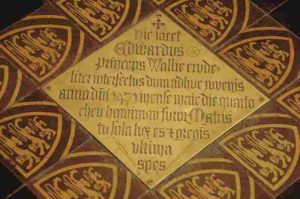
The Lancastrian Prince of Wales was laid to rest in Tewkesbury Abbey. His resting place is marked by a simple plaque above his remains.