Battles of the Wars of the Roses played a key role in political changes within Medieval England in the fifteenth century. These battles took several forms, from large pitched ‘set piece’ clashes, through to routs, skirmishes and events that are essentially large scale ambushes. The period saw private disputes fought out alongside dynastic wars, with rebellions also leading to military actions.
The Wars of the Roses also included Sieges. These too helped to change the balance of power in England and Wales.
Conflict in the 15th century
The dynastic struggle between the houses of Lancaster and York were not the only clashes of this period. There were regional disputes which turned violent as well. Some of these contributed to the outbreak of the Wars of the Roses. Others occurred during the Wars of the Roses but are not particularly related to national affairs. Similarly, the end of the Hundred Years War and Anglo-French and Anglo-Scottish relations also saw armies raised. Some of these are included in the list below, as are some of the better known skirmishes of the period.
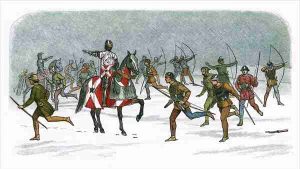
Battles of the Wars of the Roses
- 1452. Standoff at Dartford
- 1453. Hundred Years Wars: The Battle of Castillon
- 1453. Battle of Heworth Moor
- 1454. Stamford Bridge
- 1455. First Battle of St. Albans
- 1455. Battle of Clyst Heath
- 1459. Battle of Blore Heath
- 1459. Rout at Ludford Bridge
- 1460. Raid on Sandwich
- 1460. Battle of Newnham Bridge
- 1460. Battle of Northampton
- 1460. Battle of Mapastown
- 1460. Battle of Ballymacaw
- 1460. Skirmish at Worksop
- 1460. Battle of Wakefield
- 1461. Battle of Mortimer’s Cross
- 1461. Second Battle of St. Albans
- 1461. Battle of Towton [incorporating the Battle of Ferrybridge and Skirmish at Dintingdale]
- 1461. Battle of Twt Hill
- 1462. Battle of Piltown
- 1464. Battle of Dryslwyn
- 1464. Battle of Hedgely Moor
- 1464. Battle of Hexham
- 1469. Battle of Edgcote
- 1470. Battle of Nibley Green
- 1470. Battle of Losecoate Field / Empingham
- 1471. Battle of Barnet
- 1471. Battle of Tewkesbury
- 1475. Invasion of France
- 1482. Raid on Dumfries
- 1482. Invasion of Scotland
- 1483. Buckingham’s Rebellion
- 1485. Battle of Bosworth
- 1487. Battle of Tadcaster
- 1487. Battle of Stoke Field
Features of Battles in the Wars of the Roses
Assaulting fortified positions
Several of the major battles of the Wars of the Roses saw urban defences assaulted. Use of barricades alongside artillery and infantry remained a feature of warfare in the 15th century. This type of clash included the assault in the First Battle of St. Albans, at Northampton and in the Second Battle of St. Albans. All three of these major battles were victories for the side that was attacking the defended positions.
The Cavalry Charge
The romantic image of knights on horseback riding as a unit at the enemy is one that persists. Cavalry charges did happen, though not particularly often, in the battles of the Wars of the Roses. The most famous cavalry charge of the conflict was that of Richard III at Bosworth. Richard led his men on horseback toward Henry Tudor in a move that proved fatal for the last Yorkist King. Cavalry is noted in chronicle accounts of battles, with deployment at Second St. Albans being successful, and at Towton, less so.
Archery
The role of the English Archer on the battlefield had reached it’s zenith during the Hundred Years War. The massed ranks of bowmen unleashing a storm of arrows being a pivotal part of the successes at Crecy and Agincourt in particular. Archery played a key role in many later battles, though without being as decisive as it had been against French men-at-arms. Most major battles of the Wars of the Roses began with archers loosing at the infantry of the enemy. Archers were also deployed to protect against outflanking maneuvers and cavalry charges. As gunpowder based artillery became more accessible and reliable, the archers role diminished on the battlefield.
Ambush
The use of ambushes in warfare is one that persists through the ages. Catching an enemy unaware has obvious advantages for any assailant. Recent research by Paul Dawson and David Grummitt shows that this may have been what happened at the Battle of Wakefield. The tactic had also been seen in clashes leading up to the Wars of the Roses, with the Percy-Neville Feud incorporating ambushes.
A Standoff / Non Battle
Not every instance of two armies facing one another in full battle readiness results in fighting. Sometimes, the leaders of the two sides can parley and come to a negotiated end to the situation. This had happened at Dartford in 1452. It was attempted at St. Albans in 1455, where negotiations failed. Another example is that of Ludford Bridge, where the Yorkist commanders took flight without fighting once the Calais Garrison defected to the Lancastrian side. The conflict in the far north of England included pre-arranged battles which for a variety of reasons did not take place. At Alnwick in 1462 one of the largest assemblies of late medieval nobility was arrayed by the Yorkists for a Battle. The following year there was a chivalric challenge of battle made by the French commander Pierre le Brezè which never took place.
Featured Image
By M. & N. Hanhart (floruit 1839-1865) – Taken from Heritage History — War of the Roses. Picture originally published in: Church, Alfred (1885) “Of the Battle of Barnet” in The Chantry Priest of Barnet: A Tale of Two Roses, Seeley & Co., p. 208. Public Domain, via Wikipedia.