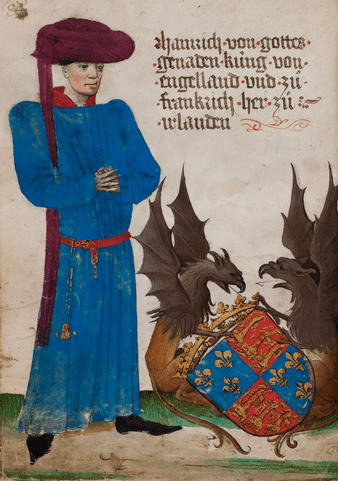
King Henry VI was born on 6 December 1421 at Windsor. He was the only child of King Henry V and Catherine of Valois. His father died on 31 August 1422, leaving the infant Henry as King of England and heir to the throne of France. The Crown of France was then claimed upon the death of Charles VI on 21 October 1422, leaving a Dual Monarchy with a very young king. His minority saw a Council rule on his behalf until he came of age.
Reign of King Henry VI
Henry VI’s reign was beset with many problems. Normandy and Gascony both fell to France in the 1450’s. Factionalism then saw the outset of the Wars of the Roses, resulting first in the Act of Accord which disinherited his son, then his being overthrown by the Yorkists. Henry VI spent most of the 1460’s in exile, hiding, or as a captive of King Edward IV. He was briefly restored in 1470-71, but died in questionable circumstances in the Tower of London on 21 May 1471.
Key Details
Born – 6 December 1421
Died – 21 May 1471
Married – Margaret of Anjou. Wedding at Titchfield Abbey in April 1445.
Children – Prince Edward (of Westminster) born 13 October 1453.
The Reigns and Coronations of King Henry VI
King of England – 31 August 1422 – 1461 (Edward IV proclaimed in early March, secured as a result of the Battle of Towton).
Coronation – 6 November 1429 at Westminster Abbey
King of England – The Readeption 3 October 1470 – death on 21 May 1471, though Edward IV was effectively restored prior to this date.
King of France – 21 October 1422 – (Disputed throughout. France, barring Calais, was lost in 1453 but the title remained claimed).
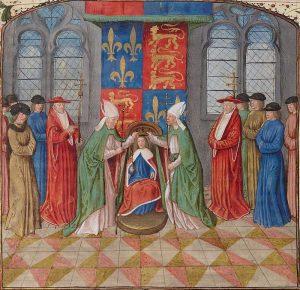
Coronation – 16 December 1431 at Notre-Dame, Paris.
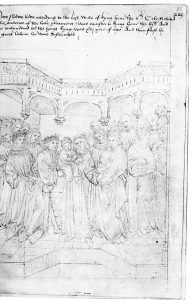

Early life: The Minority of Henry VI
Death of Henry V, Accession of Henry VI
Interim Council for the Minority of Henry VI
The Paris Coronation of Henry VI as King of France
Henry VI became King of England in his ninth month due to his father’s dead on 31 August 1422. Less than two months later the baby King Henry also inherited the throne of France, due to the death of Charles VI and the terms of the Treaty of Troyes. It led to a Dual Monarchy being in place. This saw a Council appointed to govern on collective lines during the King’s minority.
To facilitate the Dual nature of the young king’s inheritances his uncles had roles that, broadly speaking, saw John Duke of Bedford act as senior minister with the role of Regent of France. The younger of Henry’s surviving uncles, Humphrey Duke of Gloucester, had roles in the Council that governed England: though the precise nature of his role was disputed at times.

Governance in the minority of King Henry VI
In England, the Council was to rule in the King’s name on the basis of collective responsibility. Therefore a majority view of those on Council would be the position of the Crown. In time this led to some fractures as the more powerful and influential members of Council sought partly to enhance their own positions, or had strong but divergent views on important matters.
Pressing issues in King Henry’s infancy and early childhood centred around the resurgence of French resistance to English rule in France and the Economy.
King Henry VI’s Personal Rule (to 1461)
Eton College founded by King Henry VI
King Henry VI and his defence of Calais, 1452
Yorkist Letter to King Henry VI from Ludford, 10th October 1459
Lords swear oaths of allegiance to King Henry VI. December 1459
Secret Tokens used by Henry VI and Margaret of Anjou
Henry assumed personal rule in 1437. His Government still faced resistance within France and the economy was faced with a range of internal and external pressures. Henry is considered to be a pious and studious man. This is evident in early interest in education with his founding of Eton College in 1440, and later endowments for places of learning and prayer by himself and his Queen, Margaret of Anjou.
Unrest in Henry VI’s reign
Under Henry’s personal rule there were increased clashes between senior nobles. Some were perceived as being favourites, with too much influence over the King. This was noted in literature during 1450’s revolts led by Jack Cade, and was also a major factor in the exile and murder of William de la Pole, and murder of Adam Moleyns.
Political implications of King Henry VI’s marriage
Henry’s marriage to Margaret of Anjou also presented political issues. Securing the marriage contract came at a cost to England, causing political unrest amongst magnates. The Queen’s French Blood also posed a problem when the resurgence of France became a matter of military importance, then catastrophe for England. It, with other factors, led to the emergence of factions within Court and the political divide between those unswervingly loyal to the Lancastrian Court, and the adherents of the Duke of York.
Incapacity of Henry VI
Those divisions ultimately led to the outbreak of the Wars of the Roses. Alongside the political divisions were frailties of the King himself. In 1453 he fell ill and a Protectorship was established, headed by Richard 3rd Duke of York. After the First Battle of St Albans a second protectorate, again headed by the Duke of York, was established. The King’s capability was now a matter of political concern. The struggle for supremacy within this fragile government intensified and despite attempts at arbitration such as the Loveday Parade of 1458, War broke out.
Wars of the Roses
The events of 1459-61 saw Henry VI be controlled by both factions, as he was taken by the Yorkists at Northampton, then recovered by the Lancastrians at the Second Battle of St Albans. By that latter battle, the future of the Crown had become a major issue, with the Act of Accord altering the line of inheritance, and sparking a war that led to the Yorkists overthrowing Henry.
The first reign of King Edward IV
Henry VI captured by the Yorkists, 1465
Poem by Henry VI whilst in captivity
Rumour: Earl of Warwick plots to restore Henry VI. In 1467.
King Henry, Queen Margaret and Edward Prince of Wales were in York when their army was defeated at Towton on 29 March 1461. News of the loss reached them quickly and led to the Lancastrian royals and some of their closest surviving followers taking flight to the north. King Henry spent some time in the relative safety of Scotland. He was also present in the north east as his followers clung on to an enclave.
King Henry VI in hiding
Henry went into hiding as the Lancastrian hold on the north east crumbled. He stayed with loyal supporters in the north, finding his way into the north west. It was here that in 1465 his whereabouts were betrayed. Captured by Yorkists, he was taken under guard to London, where he was held securely in the Tower of London by the Yorkist regime. He is known to have written poetry whilst within the walls of the Tower.
The Readeption
The events of 1470 led to Edward IV taking flight to the Low Country. The Earl of Warwick and others restored Henry as King, albeit in name only. The readeption of King Henry VI lasted until the successful return and restoration of King Edward IV in 1471.
Proclamation for King Henry VI issued August 1470 by the Earl of Warwick
Contemporary view on the readeption
Death of King Henry VI and Posthumous matters
Veneration of King Henry VI forbidden in York (1479)
Posthumous Reversal of the Attainder on King Henry VI
Featured Image of King Henry VI
Manuscript depiction of Henry VI c. 1457. – Source. Portrait of Henry VI in the journal of Swabian knight Georg von Ehingen. Public Domain via Wikimedia –CC BY-SA 4.0

Links on King Henry VI
Schoolshistory – my biography of Henry VI for students.
Pingback: Secret Treaty between Brittany and Burgundy, April 1423
Pingback: Trial of Joan of Arc - The Hundred Years War
Pingback: Petition to Henry VI from Dutch Merchants