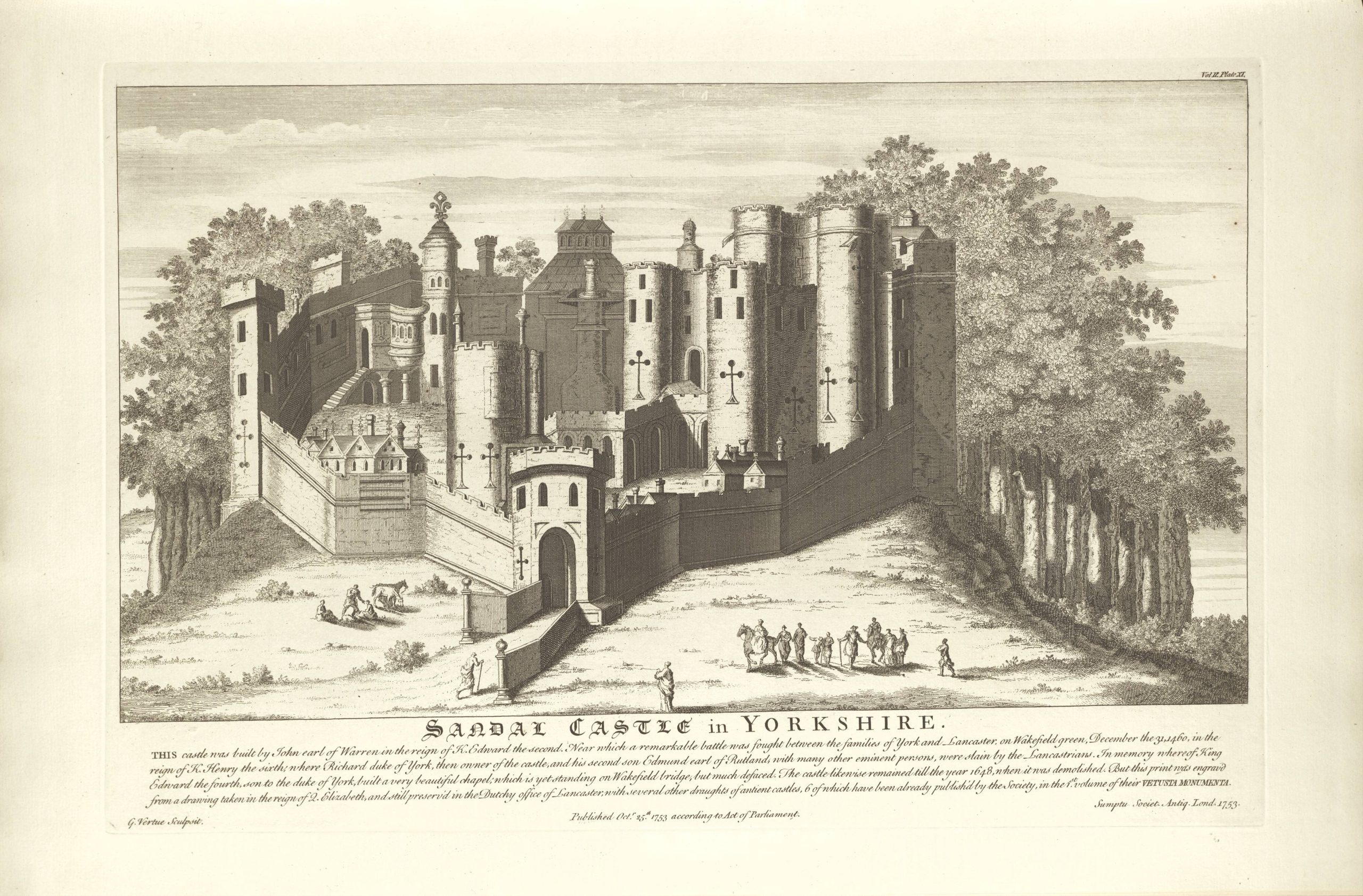
The Battle of Wakefield is commonly said to have been fought on 30 December 1460 outside the Duke of York’s castle at Sandal, Wakefield. The Battle was hugely consequential, resulting in the deaths of Richard Plantagenet, 3rd Duke of York, his son Edmund Earl of Rutland, and Richard Neville, Earl of Salibury. In one afternoon, the Yorkist preeminence that had been in place following their return from Calais and Ireland was shattered. Now, the Act of Accord‘s worth was in serious doubt and with that, the only viable options for the remaining Yorkist magnates were to fight, or flee once more.
New research by historians Paul L Dawson and David Grummitt illustrates that the traditional accounts of the Battle of Wakefield are largely inaccurate. Drawing on a wide range of previously uncited contemporary records, their findings cast serious doubt on accepted history. The fate of Richard Duke of York, of his son Edmund Earl of Rutland, and the date and location of the [limited] fighting are all shown to be far from what is popularly believed.
![Battle of Wakefield [December 30th, 1460]. (The battlefield; all there is left of Sandal Castle; Richard, Duke of York; relics of the fight.)](https://thewarsoftheroses.co.uk/wp-content/uploads/2021/09/nypl.digitalcollections.510d47dd-b2e6-a3d9-e040-e00a18064a99.001.w.jpg)
The Battle of Wakefield of 1460 Reconsidered
Paul L. Dawson and David Grummitt
Abstract
The Battle of Wakefield in December 1460 was a crucial encounter in the first stage of the Wars of the Roses. It saw the death of Richard, Duke of York and his brother-in-law, Richard Neville, Earl of Salisbury, in a series of events which contemporaries and later historians have struggled to explain. Various theories have been offered for York’s defeat, but almost all modern accounts agree that, contrary to all military logic, the duke left his stronghold of Sandal Castle and was overwhelmed by a much larger Lancastrian force. The earliest contemporary records, however, do not support this explanation. They suggest that, instead of being killed in battle, York was captured and murdered in cold blood. Moreover, they suggest that the favoured date of the battle – 30 December – was the date of Duke Richard’s death and that he was captured in an engagement which took place the previous day, 29 December 1460. Indeed, it is difficult to see how events at Wakefield constituted a battle in any meaningful sense. Our understanding of Wakefield has important ramifications for how we consider and reconstruct the battles of the Wars of the Roses more generally.
The Research: The ‘Battle’ of Wakefield of 1460 reconsidered. Paul L Dawson and David Grummitt. Battalia Volume III 2025. Also available via the Open University Research Repository.
Revelations about the Battle of Wakefield
Some of the key points in the research of Paul and David are:
- The common ascertion that the Battle of Wakefield took place outside Sandal Castle is not supported by contemporary records or accounts.
- The clash was not one in which organised forces met on a field of battle. Rather, the evidence suggests it was more akin to a violent ambush.
- The engagement in which the Duke of York was captured took place on 29 December 1460, not on 30 December as is almost universally stated.
- Richard Duke of York was not killed on a battlefield, he was most probably murdered after being captured.
- The commonly told tale of Lord Clifford butchering the Earl of Rutland on Wakefield Bridge is not supported by evidence. Indeed, it appears to be a much later and fanciful description that cannot be substantiated.
How can so many accounts of the Battle of Wakefield be wrong?
In making assertions that so much of the accepted version(s) of events in the Battle of Wakefield are simply inaccurate, Dawson and Grummitt are flying in the face of centuries of historical narrative. How can it be the case that so many reputable historians, local antiquarians, and national bodies be wrong about even the basics of a series of hugely significant events?
Dawson and Grummitt are well aware of the doubts that some may have about their findings. The research on the Battle of Wakefield has, therefore, been run past a range of historians, peer reviewed, and double checked in some depth. They note the issues with the formation of the previously understood and accepted narrative of the Battle of Wakefield within their paper.
Acceptance of Popularised Narrative
In simple terms, the lack of clarity on the specifics of the events seems to have enabled a few theories to become accepted. Much like the impact of folklore, the versions of men such as Edward Hall have simply become accepted. And, these versions persist because there is a degree of support for the inaccurate accounts from a raft of near contemporary accounts.
But, those accounts are not written by eyewitnesses. Nor are they based upon evidence from the field, or from hard fact gathered in inquiries in the area in which the Duke of York, Earl of Rutland, and Earl of Salisbury met their end. The proliferation of London based ‘gossip’ accounts simply became the norm. It led to a lack of questioning as to the validity of accounts: few historians have ever, for example, queried what the original source of information in Hall, Wavrin et al is [it can generally be traced to one man, the Earl of Warwick, who was not there…]
Lack of contemporary accounts
Despite the significance of this battle, little was actually recorded about it at the time. There are no contemporary Lancastrian accounts of the battle that we know of. Nor are there any contemporary accounts written by Northern chroniclers, who would have better access to the Lancastrian peers and soldiers who had rallied to Margaret of Anjou‘s call to arms.
Incomplete Chronicle Evidence about the Battle of Wakefield
As a consequence, it has been incredibly difficult to discern some of the most significant issues surrounding the battle of Wakefield. We do not know with any degree of certainty why Richard 3rd Duke of York and his affinity found themselves in a combat scenario. There is a lack of definitive as to the numbers on the field for either side. Tactics and a suggestion of trickery are difficult to establish facts on. Even the nature of the deaths of the Duke of York and Earls of Rutland and Salisbury are unclear, with tales emerging years after the event that may or may not have been influenced by political biases.
All that really can be stated with any certainty from the chronicle accounts and early letters is that in late December 1460 a Battle was fought. That it was fought in or near Wakefield. And, that the battle was a Lancastrian victory. We can also state with certainty that the aforementioned Yorkist Peers were killed, either in or shortly after the battle. Even with these basic facts there are anomalies within contemporary and near contemporary accounts and references. This is why the research by Dawson and Grummitt is so groundbreaking, it goes far beyond the normal reliance on chronicles and well known letter collections.
![Battle of Wakefield [December 30th, 1460]. (The battlefield; all there is left of Sandal Castle; Richard, Duke of York; relics of the fight.)](https://thewarsoftheroses.co.uk/wp-content/uploads/2021/09/nypl.digitalcollections.510d47dd-b2e6-a3d9-e040-e00a18064a99.001.w-300x167.jpg)
Aftermath and Consequences of the Battle of Wakefield – in contemporary evidence
The aftermath and consequences of this notable clash are clearer. The heads of the Duke of York, his son, and the Earl of Salisbury are known to have been displayed over Mickelgate Bar in York. The Lancastrians are known to have awaited the return of Queen Margaret from Scotland, then marched south on London, winning a victory over the Yorkists commanded by Richard Neville 16th Earl of Warwick at St. Albans. So too do we know that the eldest of Richard 3rd Duke of York’s son assembled a force in the west of England which defeated a Lancastrian army at Mortimer’s Cross. The actions that then followed these consequences of the Battle of Wakefield are well documented, and culminated in the Yorkist victory at Towton on Palm Sunday [29 March] of 1461.
What does early evidence about the Battle of Wakefield tell us?
News of the events would take several days to reach the kin of the defeated Yorkists and diplomatic circles in Westminster and London. This news would come from messengers, possibly from some who fought and fled the scene, and from non eye witness accounts from travellers. Within a week of the clash, enough news of the events had been gathered for Diplomats from the Italian City States to write about the Battle of Wakefield. These diplomatic dispatches are the earliest written record that have survived to record the events at Wakefield.
January 9 1461. Francesco Coppino, Papal Legate and Bishop of Terni wrote to Francesco Sforza, Duke of Milan.
The relevant section of his letter is as below:
Jan. 9. Potenze Estere. Inghilterra. Milan Archives.
Francesco Coppino, Bishop of Terni, Papal Legate, to Francesco Sforza, Duke of Milan.
I trust all will be remedied, though the perils are great, the Earl of Warwick being here with the king, who, together with the neighbouring population, is well disposed towards my intention. I have recommended them in the meanwhile not to give battle to desperate enemies, who are, moreover, strong in consequence of this victory, but to remain on the defensive until Easter. In the meantime I am, with the consent of the majority, negotiating an agreement by fair means; and my reputation must receive support from Rome, my legation and Warwick requiring nothing else. For its attainment letters and commissions have been drawn up here in conformity with my wishes, as you will learn from Messer Antonio. I shall have effected wonders if the affair succeed. A large army is now being formed, and after despatching these matters, which will occupy but few days, the king will advance, being guided by one who has the wish, the victory being recent, although he did not indicate this openly to me: it will suffice for the accomplishment of our affair.
London, the 9th January, 1461.
[Italian.]Note: this letter, with a slightly different translation, also appears in the State Archives of Venice. Dated exactly the same but with some differences.
‘Milan: 1461‘, in Calendar of State Papers and Manuscripts in the Archives and Collections of Milan 1385-1618, ed. Allen B Hinds( London, 1912), British History Online
Key Points
- The enemy, ie the Lancastrians, had won a victory.
- That the Earl of Warwick and Bishop Coppino had discussed, either in person or via letters, the military and political scenario resultant from the Battle of Wakefield. And that the Bishop had advised the Earl to ‘remain on the defensive until Easter‘.
- A response was already underway from the Yorkists in London. ‘A large army is now being formed‘ which would take ‘but few days‘.
January 9 1461. Antonio de la Torre to Francesco Sforza, Duke of Milan
Jan. 9. Potenze Estere. Inghilterra. Milan Archives.
Antonio de la Torre to Francesco Sforza, Duke of Milan.
It is now many days since I was despatched on my way back with every commission fitting and favourable for public and private affairs. I am charged to make every demand by word of mouth…
Some of the lords of the queen’s party, rendered desperate by the victory of the lords here, and especially by the Earl of Warwick, assembled a force in the northern parts, eighty miles from London, to come and attack their opponents here who are with the king, and get back the king into their power, as they had him before. Accordingly the Duke of York, with two of his sons and Warwick’s father, the Earl of Salisbury (Dariberi), went out to meet them. And it came to pass that, although they were three times stronger (piu forti tretanti), yet from lack of discipline, because they allowed a large part of the force to go pillaging and searching for victuals, their adversaries, who are desperate, attacked the duke and his followers. Ultimately they routed them, slaying the duke and his younger son, the Earl of Rutland, Warwick’s father and many others. This news caused great alarm in these parts, although it seems Warwick was not there.…with their affection for the king and Warwick, hearing that the legate was present and remembering the advantage his presence was to them on the last occasion, all took heart and mustered gladly, so that they hope in a month or two to have more than 150,000 men in camp. The belief is that if peace does not ensue the consequent devastation will be worse than has been seen in this realm for a thousand years …
London, the 9th of January.
Postscript.—This engagement took place on the last day but one of December near a castle called Pontefract.‘Milan: 1461‘, in Calendar of State Papers and Manuscripts in the Archives and Collections of Milan 1385-1618, ed. Allen B Hinds( London, 1912), British History Online
Key Points
- Torres said that the Yorkist force was three times as large as their adversaries.
- The Yorkists were routed.
- In the engagement, the Duke of York, Earl of Rutland, and Earl of Salisbury were ‘slayed‘.
- Londoners were alarmed by news of the victory.
- Yorkists in London, led by the Earl of Warwick, were recruiting heavily.
January 11 1461 Richard Neville 16th Earl of Warwick to Pope Pius II
Jan. 11. Potenze Estere. Inghilterra. Milan Archives.
Richard Neville, Earl of Warwick, to Pope Pius II.
Your Holiness must not be troubled if you have heard of the events in England and of the destruction of some of my kinsmen in the battle against our enemies. With the help of God and the king, who is excellently disposed, all will end well. We shall obtain either a fair and sure peace or victory, especially if you confer the long-expected promotion on your legate. The people will then see that our adversaries, who daily scorn your authority and the legate’s, and say the latter has no power and is no legate, adding marvellous falsehoods to make him unpopular, to the detriment of the Church and the king. If, according to your former letters, you value my allegiance and the allegiance of those who are conscientiously aiding the king and the legate (in conformity with the statement of Dom. Antonio della Torre, his Majesty’s ambassador), it will be necessary so to deal with us and the legate that all may know such to be the fact, and that he may bear the cross which you sent him without envy and opposition on the part of our two archbishops and primates, as dom. Antonio, the bearer, can inform you. Be pleased to give him full credence, and do not desert me and the others, whom you formerly received as sons, for eventually you will see us end well and devoutly. The king sends his recommendations and desires certain concessions, which Antonio will declare.
London, the 11th January, 1461.
[Latin; copy.]‘Milan: 1461‘, in Calendar of State Papers and Manuscripts in the Archives and Collections of Milan 1385-1618, ed. Allen B Hinds( London, 1912), British History Online
Key Point
- Kinsmen of the Earl of Warwick have been killed in a battle with their enemies, the Lancastrians.
February 1 1461. Milanese Ambassador to the court in France to the Secretary of the Duke of Milan.
Feb. 1. Potenze Estere. Francia. Milan Archives.
Prospero de Camulio, Milanese Ambassador to the French Court to Cicho Symoneti, Secretary to the Duke of Milan.
The news from England is that the queen has recently fought with the Duke of York and taken York, which is a fine city. The king and the Earl of Warwick thought that the forces of the duke and of the earl’s father and brothers were sufficiently strong, but they were defeated, and there were slain the duke, his son, the Earl of Warwick’s father and his two sons and 12,000 to 16,000 men. Many others, the numbers unknown, were slain in other battles subsequently; it is said to amount to thousands. When the king heard this he was much moved, although the Duke of York seems rather to have been slain out of hatred for having claimed the kingdom than anything else. It was decided that the Earl of Warwick should go to avenge the affront, and he has gone with 60,000 combatants; some say more. Things remain in the balance, and so the Dauphin considers that I must not at present think of going to do anything in England, and just the same with the Burgundians.
Ghent (Genepre), 1st. February, 1461.‘Milan: 1461‘, in Calendar of State Papers and Manuscripts in the Archives and Collections of Milan 1385-1618, ed. Allen B Hinds( London, 1912), British History Online
Key Points
- The Queen [Margaret] has taken York.
- The Duke of York, Earl of Rutland, Earl of Salisbury ‘and his two sons‘ along with 12,000 to 16,000 men died.
- Fighting subsequent to that at Wakefield had taken place, killing thousands. Before 1 February 1461.
- Richard Neville, Earl of Warwick has an army of 60,000 men to ‘avenge the affront‘.
- Things are ‘in the balance‘.
January 23 1461. Paston Letters, Clement Paston to John Paston
And my Lord Fitzwater is ryden northewards, and it is sayd in my Lord of Cawnterberys howse that he hethe takyn ijc. [200] of Andrew Troloppys men. And as for Colt, and Sir Jamys Strangwysse, and Sir Thomas Pykeryng, they be takyn or ellys dede. The comyn voysse is that they be de dede. Hopton and Hastyngs be with the Erle of Marche, and wer no at the fewlde. Wat word that ever he have fro my Lords that be here, it is well doo, and best for yow, to see that the contre be allweys redy to come bothe fote 250men and hors men, qwen they be sent for; for I have herd seyde the ferthere Lords will be here soner that men wen, I have arde sayde, er iij. weks to an ende; and also that ye xwld come with more men, and clenlier arayed than anoder man of yowr cwntre xwld, for it ly the more up on yowr worchyp, and towcheythe yow more nere than odermen of that cwntre, and also ye be mor had in favor with my Lords here. In this cwntre every man is well wyllyng to goo with my Lords here, and I hope God xall helpe hem, for the pepill in the northe robbe and styll, and ben apoyntyd to pill all thys cwntre, and gyffe a way menys goods and lufflods in all the sowthe cwntre, and that wyll ask a myscheffe. My Lords that ben here have as moche as they may do to kep down all thys cwntre more than iiij. or v. schers, for they wold be up on the men in northe, for it ys for the welle of all the sowthe.
The Paston Letters, A.D. 1422-1509. Volume 3 (of 6)
Key Point
- Colt, Sir Jamys Strangwysse, and Sir Thomas Pykeryng are believed to have died in the battle.

Chronicle Accounts of the Battle of Wakefield
The above letters are all written in the weeks that followed the Battle of Wakefield. The purpose of these letters was not to record the nature of the fighting, nor the scale of the battle. In most cases, the purpose of the letters was diplomatic whilst the Paston Letter included above is a more general passing of information about matters that may impact directly upon the affairs of that family. As such, none of the references written in the immediate aftermath of the Battle of Wakefield are specific to the battle itself, instead they focus mainly upon the responses to the battle and its outcome.
To begin to explore the the way in which the battle itself was fought, it is necessary to look at other sources of information from the period. One area that informs is the available Chronicle accounts that were written. These vary in terms of when they were penned and are often heavily influenced by the scribes affiliation to one party or the other. In the case of chronicles written relatively soon after the Battle of Wakefield, they are exclusively Yorkist in their leaning. Those written several decades later, after the fall of the House of York, tend to be more sympathetic to the Lancastrian cause.
Provenance of Chronicle Accounts
The provenance, accuracy and bias of the Chronicle accounts relating to the Battle of Wakefield is explored in detail in Keith Dockray’s article on the Battle of Wakefield.
Chronicle of England from Rollo to Edward IV
And the said Harry and his counsell for because the Comons of England found that Richard
Plantagenet othirwise called Richard late Duke of Yorke hadde more right and more title vnto the
Crowne of England than the saide Harry, he innocent goyng towarde Yorke at Wakefeld sette
vpon hym oute of array and kelled hym and his sonne the Erle of Routeland, the Erle of
Salusbury and Lord Harington with othir diuers gentills and comoners. (420-21)Quoted on Page 73 of this thesis, in the footnotes.
Comments
This chronicle is believed to have been written relatively soon after the Battle of Wakefield. However, it is brief in its description of this and other events. As such it simply confirms that a battle had been fought in which the Duke of York, Earl of Rutland, Earl of Salisbury and Lord Harington with others had been killed. The provenance of this chronicle is explored in: Raluca Radulescu. “Yorkist Propaganda and ‘The Chronicle from Rollo to Edward IV.’” Studies in Philology, JSTOR.
An English Chronicle
Thys same yeere, in the moneth of Decembre, the duk of Somerset and the erle of Deuenshyre went in to the Northcuntre, wythe viij.c. men : and anone after the seyde duk of York, the erle of Rutland hys sone, and the erle of Salesbury, a lytelle before Crystynmas, wyth a fewe personnes went in to the Northe also, for to represse the malyce of the Northermenne the whyche loued nat the sayd duk of York ne the erle of Salesbury, and were loged at the castelle of Sandale and at Wakefeld.
Than the lord Nevyle, brother to the erle of Westmorland, vnder a falce colour wente to the sayde duk of York, desyryng a commys syone of hym for to reyse a peple for to chastyse the rebelles of the cuntre ; and the duk it graunted, demyng that he had be trew and on hys parte. When he had his commyssyone he reysed to the nombre of viij. M1. men, and broute thaym to the lordes of the cuntre ; that ys to say, the erle of Northumbrelond, lord Clyfford, and duke of Somerset, that were aduersaryes and enemyes to duke Richarde. And whan they sawe a conuenient tyme for to fylle theyre cruelle entent, the laste day of Decembre they fyll oponne A.D. 1460. the sayde duk Rychard, and hym kylde, and hys sone therlle of Rutland, and meny other knyghtes and squyers ; that ys to say, the lorde Haryngtone a yong man, Thomas Haryngtone knyght, ser Thomas Nevyle sone to therlle of Salesbury, and ser Harry Ratford knyghte ; and of other peple to the nombre of M1. Mcc. The erle of Salesbury was take alyue, and lad by the sayde duk of Somerset to the castel of Pountfreete, and for a grete summe of money that he shuld haue payed had graunt of hys lyfe. But the commune peple of the cuntre, whyche loued hym nat, tooke hym owte of the castelle by violence and smote of his hed.
Whan the dethe of these lordes was knowe, greete sorow was made for thaym; and anone, by the kynges commaundement, wry ttes and commyssiones were sent and direct to the Shyreues and other officers, to reyse peple for to chastyse the peple and the rebelles of the North. And they of the Northe heryng thys gadred pryuyly a grete peple, and came doune sodeynly to the towne of Dunstaple, robbyng alle the cuntre and peple as they came; and spoylyng abbeyes and howses of relygyone and churches, and bare awey chalyces, bookes and other ornamentes, as thay had be paynems or Sarracenes, and no Crysten menne.
An English Chronicle of the Reigns of Richard II, Henry IV, Henry V and Henry VI. Camden Society. London. Pages 105-107.
Comments
An English Chronicle was written shortly after the Battle of Wakefield, with the final events covered taking place in 1461. As such it is a contemporary account. This account suggests that the Lancastrian force tricked the Duke of York. Specifically, it noted that Lord Neville used false colours: ‘the lord Nevyle, brother to the erle of Westmorland, vnder a falce colour.’ [Note the contrast with Waurin on the possible use of deceit]. The chronicle confirms that the Duke of York and Earl of Rutland, along with others, died in the battle. It also states that the Earl of Salisbury was captured and taken to Pontefract. The Earl was initially to be ransomed, ‘and for a grete summe of money that he shuld haue payed had graunt of hys lyfe. But the commune peple of the cuntre, whyche loued hym nat, tooke hym owte of the castelle by violence and smote of his hed‘.
Register of Abbot Whethamstede
Translated from the original Latin text
When this had been done, and he [the duke of York] had stood thus declared, and also proclaimed, both in the city of London, and also in all the notable towns of the surrounding counties, he immediately took, as if afterwards, both license and authority, to the Lord King, to march towards the northern parts, to subjugate the people of that country, who, at the instance of Lady Margaret the Queen, and of several of the lords adhering to her, rebelled against him, and against his own cry, by common will and concord. He was certainly licensed by the Lord the King, and took his journey towards the northern parts, taking the journey with him the illustrious lord, Lord Richard Neville, Earl of Salisbury; and as they went on, they both gathered together in the progress of their journey, by the authority of the royal commission, not a small multitude of the people, for the defence of their persons, and for the oppression of the opposing crowd. With whom, advancing separately, for the sake of having better hospitality in their journeys, they arrived at last at the said village of the Lord Duke, a town, namely, of Wakefield, which is below the capital of the County of York. When they heard that the northerners were approaching in the greatest number of the people, and that they had encamped not far from their camp, they chose a camp for themselves there near the town. and erecting their tents, they encamped in the same place for a day between the parties, punctuated by the time of the battle.
And hearing the northerners, and their leaders, who were always in deceit, always in snares, sat diligently, and were often wont to throw out combs with hides, and marrubiums with honey, how the southerners governed themselves in their camp for a little while, and wandered about in the parts for accumulating victuals, and did not they should return every hour well alert, and fully prepared in arms against the ambushes and invasions of the enemy; soon, contrary to the promise made, and this day of battle punctuated, they rushed upon them, and overwhelming them with the mass of their multitude, compelled many to fall in the field, and some to flee from the field; but they captured the two said Lords alive in the war, and they themselves, and especially the Duke of York, engaged in much mockery. For setting him upon a small mound of ants, and which I will call a lowly sward, made of marsh grass, and placing it upon his head in the manner of a crown, no differently than the Jews before the Lord, they bowed their knees his own before him, saying delusionally, “Hail, king, without government. Hail, king, without inheritance. Hail, leader and prince, completely without all people and possessions.” And with these, together with various others, speaking against him with reproachful and insulting words, they forced him at last, by the head severance, to leave a claim to be sure of a just revenge.
And they took the lord of Salisbury with them as far as the castle at the Broken Bridge, and there, at the impious and importunate instigation of certain perverts, they beheaded him. And it is evident in these few, what was the nature of the said Lord Duke’s return to the kingdom, entering the Parliament, and progressing to the parts of Borea, and finally a kind of retreat, by the fate of the world, from the earthly and transitory kingdom to the region, as it was hoped, heavenly, and lasting eternally without end.
Wherefore, for a prompter and more recent remembrance of the day, place, and year, of the death of the said Lord Duke, and upon the brevity of the name of his rightful heir, here is written further of all these in short metrical style under these words:
In the year one thousand, one hundred and four times, ten times,
Three days and twelve days, in the twelfth month of December,
Down in York, near Wakefield, County, Duke, lord of the town, is reported to have fought
A great conflict against the northern nation,
And several nobles, who presided over the nations themselves.
Whereupon he taught that fate is a matter of fortune. Accordingly
He avoids delaying, the Duke fell, born and his,
And the distinguished Earl. The fate of the war was the fate of Obvia themselves.
An omen and that fate had brought sorrowful change,
To be mourned by many; the right of the kingdom was his right.
The names and surnames of those illustrious men who fell in the said war, in the war he saw committed at Wakefield, see elsewhere in the second Register, a little shorter.
Comments
The Abbot is clearly sympathetic to the Yorkist cause. He has described the Lancastrians as rebels and notes that Richard Neville, Earl of Salisbury, was an illustrious lord. The Register suggests that both sides had large armies. Of the Yorkists he notes that they recruited ‘not a small multitude‘ and the ‘northerners’ [Lancastrians] advanced upon them with the ‘greatest number of the people‘. Unlike earlier and most other contemporary accounts, the Abbot hints at the nature of the clash. After several days of truce during which victuals had been acquired by the Yorkists, the Lancastrians fell upon them: ‘and this day of battle punctuated, they rushed upon them, and overwhelming them with the mass of their multitude, compelled many to fall in the field, and some to flee from the field‘. The attack was whilst a truce was in place but not wholly unexpected if Abbot Whetmanstede’s account is reliable. He notes that the Yorkists whilst gathering supplies were: ‘fully prepared in arms against the ambushes and invasions of the enemy; soon, contrary to the promise made… [the attack happened].’ In contrast to other accounts the Register notes that ‘they captured the two said Lords alive in the war‘ and that one of these was the Duke of York. In this account, the Duke is mocked by his captors on the field of battle, crowned by them, then beheaded by them. If accurate, he did not die in the battle itself but by means of a hasty execution. The Earl of Salisbury, says Whetmanstede, was taken to Pontefract Castle where, ‘there, at the impious and importunate instigation of certain perverts, they beheaded him‘. There is no reference to the fate of the Earl of Rutland, or any other Lords or knights who were at the Battle of Wakefield.
John Benet’s Chronicle
Et in vigilia sancti Andrie prorogatum est parliamentum usque vicesimum octavum diem mensis Januarii. Et in vigilia sancti
Nicholai pro tune die Veneris dux Eboraci, Comes Sarum et Comes Retelande exierunt de London’ usque villam de Notingham’ et sic usque castrum de Sandalle cum xij milibus hominum. Et in Crastino sancti Thome martyris venit quasi subito contra eos
dux Somersetie et Cum eo Comes de comitatu Devonie, Comes Northumbrie, dominus la Ros, dominus Cleford, dominus la
Nevylle, dominus la Fiz Hew, dominus la Warre, Baro de Greystoke et multi alii quasi viginti milia. Et ibi? interfectus est Comes Sarum et Comes Retlandie, dominus Thomas Nevylle, dominus Thomas Heryngton’ et multift alii numero quasi milia hominum. Et ibi interfectus est Ricardus dux Eboraci.Harriss GL, Harriss MA. III John Benet’s Chronicle for the years 1400 to 1462. Camden Fourth Series. 1972;9:151-233. doi:10.1017/S0068690500002877
Comment
Benet notes that the Duke of York, Earl of Salisbury and Earl of Rutland had marched from London to Sandal Castle via Nottingham. They had a force of 8000 men. The Lancastrian army was led by the Duke of Somerset, Earls of Devon and Northumberland, Lords Clifford, Roos, Neville [of Westmorland], FitzHugh, Warre, Baron Greystoke and ‘many others‘. Bent says that the Lancastrian force numberered 20,000 men. Of the battle itself, Benet says nothing beyond the names of some notable men who were slain [the Duke of York, Earls of Rutland and Salisbury, Lords Thomas Neville and Lord Harington]. He states that about a thousand men perished in the battle.
John Bale’s Chronicle
Item upon Cristemas day and newyeres day the king yede crouned a procession at powles and on cristemas day the king fested atte Bisshops paleys at london the maior aldremen of this citee and er was greet rialte. And on the morn after newe yeresday cam hevy word and tidings to the king and my lord of Warrewik that the duke of york, the Erie Rutland his sone and the Erie Salesbury wer trayterously and ageinst lawe of armes be taking of Tretys graunted, mordred and slain in the north beside pountfreite in a feld called wakefield by the fals meanes and power arrered by the duk of Somerset the Erie Northumberland the lorde Roos and the lord Clifford and the lorde Nevyll and andrewe trollop and ojiers.
Bale’s Chronicle in Six Town Chronicles. via archive.org
Comment
Bale says that news of the Battle of Wakefield reached the Earl of Warwick on 2 January 1461. It identifies the Duke of York and Earls of Rutland and Salisbury as having been ‘mordred and slain in the north beside pountfreite in a feld called wakefield‘. Of the Lancastrian force it notes it having led by the Duke of Somerset, Earl of Northumberland, the Lords Roos, Clifford, Neville [of Westmorland] and also notes that Andrew Trollope was present. Bale notes ‘false meanes‘ but does not elaborate upon this so could mean trickery, or simply that the Lancastrians were the rebel force on this occasion.
Chronicle of England – the Wavrin Theory
The Duke of York, therefore, being retreated to Wakefield, upon hearing news that Queen Margaret was coming with a great force of armed men to fight him, accompanied by the Duke of Somerset, was greatly astonished, as he did not have sufficient troops at the moment to resist such great power. He and the Earl of Salisbury, along with others in their company, spoke together to conclude their affairs. They sent for men from all sides, fortifying themselves to the best of their ability within the town. However, all this was in vain because at the moment they were attacked, most of their men had gone out for foraging. Additionally, Andrew Trollope, who was a very cunning military man, told the Duke of Somerset that he knew well that they could not force the Duke of York out of the town without a great loss of men. He found a way throughout the night to dress his men in coats bearing the badge of the Ragged Staff, which belonged to the Earl of Warwick (age 33) and were recognized as such, thus they appeared to be four hundred of the bravest men, well-instructed in what they had to do secretly. Their plan was to go straight to the town and tell the Duke of York that they came from the county of Lancashire to aid him.
When the Duke of York, who never suspected treachery, saw these companions approaching, he was very joyful and allowed them inside the town. That same night, the Duke of York ordered a strong guard because he knew well that the Duke of Somerset was in the fields, intending to confront him with all his might.
But when day broke, Andrew Trollope, accompanied by other soldiers all wearing the badge of the Ragged Staff, sent word to the Duke of York, without revealing his identity, that they were a large force come to his aid. The Duke was overjoyed and marched out of the town with the intention of engaging his enemies. At that moment, Andrew Trollope, the traitor, knowing that the Duke of Somerset was nearby, initiated the skirmish, and the Duke of Somerset, ready for action, charged fiercely upon the Duke of York and his men. Quickly, Andrew Trollope and his group, as well as those who had been sent by him into the town that night, turned against the Duke of York and his followers. In this battle, the Duke of York, the Earl of Rutland his son, the Earl of Salisbury, Sir Thomas Neville his son, and many other noble men of their company were killed. This battle took place outside the town of Wakefield on the penultimate day of December in the year fourteen sixty. Queen Margaret was very joyful upon hearing this news, as were all those supporting her cause. On the other hand, the Earls of March and Warwick, who had lost their fathers in this battle, were deeply saddened and angered, but for the time being, they could not rectify the situation.
Wavrin, Jean. A Chronicle of England. Volume Six, Chapter 3.
Comment
Wavrin notes that the Duke of York and Earl of Salisbury had been shocked by the size of a Lancastrian force gathering in the north and had recruited to address the situation. He also notes that the Duke of York, Earls of Rutland and Salisbury and Sir Thomas Neville were slain in the battle of Wakefield on 30 December 1460.
The Wavrin Theory on the Battle of Wakefield
Wavrin’s Chronicle is the earliest to elaborate on the possibility of the Duke of York and Earl of Salisbury having been deceived.
“He [Andrew Trollope] found a way throughout the night to dress his men in coats bearing the badge of the Ragged Staff, which belonged to the Earl of Warwick (age 33) and were recognized as such, thus they appeared to be four hundred of the bravest men, well-instructed in what they had to do secretly. Their plan was to go straight to the town and tell the Duke of York that they came from the county of Lancashire to aid him”.
Wavrin then says that Trollope sent word to the Duke of York, without revealing his own identity, that this group of 400 men were supporters of the Yorkist cause. The Duke was ‘overjoyed‘ by this and allowed Trollope’s band to approach. This was then used by the Lancasatrians to ensnare the Yorkists in a trap. As Trollope’s men arrived they revealed their true colours, attacking the Duke of York’s men, at this signal, the Duke of Somerset launched another assault. Thus the Yorkists were taken by surprise and hit by two attacks at the same time.
The suggestion here then is that the Lancastrians utiised a trick designed by Andrew Trollope to lure the Duke of York from the relative safety of Sandal Castle. It was timed so that Trollope’s detachment arrived whilst many of the Yorkist force was away from the castle foraging. So, even if the Yorkists relaised a trap was being set, they would not have their full force available.
Wavrin is the only contemporary or near contemporary account to put this version of events forward. It is likely that Wavrin based his accounts on now lost newsletters, most likely from the earl of Warwick. Note the differences Wavrin’s account has with those in An English Chronicle [above] on the possible use of deceit by the Lancastrian force at Wakefield.
Croyland Chronicle
After the conclusion of these matters, towards the close of the same year, it being the week of our Lord’s Nativity, the said Richard, duke of York, incautiously engaged the northern army at Wakefield which was fighting for the king, without waiting to bring up the whole of his own forces; upon which, a charge was made by the enemy on his men, and he was without any mercy or respect relentlessly slain. There fell with him at the same place many noble and illustrious men; and countless numbers of the common people, who had followed him, met their deaths there, and all to no purpose.
The duke being thus removed from this world, the northmen, being. sensible that the only impediment was now withdrawn, and that there was no one now who would care to resist their inroads, again swept onwards like a whirlwind from the north, and in the impulse of their fury attempted to overrun the whole of England.
Ingulph’s chronicle of the abbey of Croyland with the continuations by Peter of Blois and anonymous writers.
Comment
The account in the Croyland Chronicle was penned by the first continuor in the 1470’s. It notes that the Duke of York engaged the enemy ‘incautiously’ and without having waited for all of his forces to be present. The enemy, the Lancastrians, charged the Duke’s men and he along with ‘many noble and illustrious men and countless numbers of the common people‘ were slain. The aftermath of the battle of Wakefield was the Lancastrian advance on London, described as being ‘like a whirlwind from the north‘.
The new chronicles of England and France, in two parts : by Robert Fabyan
Therefore it was agreed by the lordys tha at London present, that the duke of Yorke shulde take r hym the erle of Salesbury, with a certeyn people, to fetche in the sayde quene and lordys abouesayde ; the whiche duke & erle departyd from Lodon w theyr people vpon the seconde daye of Deceber, so sped them northwarde. Wherof the quene with hyr lordys beynge ware, & hauynge with them a great strength of northerne1, mette w the duke of Yorke vpon the. xxx. daye of December nere a towne in the northe callyd Wakefelde, were atwene them was foughten a sharpe fyght, in whiche the duke of Yorke was slayen, w his sone callyd erle of Rutlande, & syr Thomas Neuyll, sone vnto the erle of Salesbury, with many other, & y erle of Salesbury was there taken on lyne with dyuerse other. Whan the lordys vpon the quenys “partye hadde gotten this vyctory, anon they sent theyr prysoners vnto Pountfreyt, the whiche were after there behdyd, that is to meane, the erle of Salesbury, a man of Lodon, namyd lohn Harowe, ard an other capytayne namyd Hanson, whose heddys were sent vnto Yorke, and there set vpo the gatys.
The new chronicles of England and France, in two parts : by Robert Fabyan. Edited by Sir Henry Ellis and published in 1811. Pages 637-638.
Comment
Fabyan states that the Duke of York and Earl of Salisbury marched from London on 2 December and fought at Wakefield on 30 December 1460. The battle itself is noted only as being ‘a sharpe fyght, in whiche the duke of Yorke was slayen, w his sone callyd erle of Rutlande, & syr Thomas Neuyll, sone vnto the erle of Salesbury, with many other‘. The Earl of Salisbury ‘with dyuerse other‘ was captured, taken to Pontefract and beheaded. The heads of those executed were sent to York and displayed upon the gates of the city.
A Chronicle of London
and the duke of Yorke came out of Irland, and to Westm the xth day of Octobre, and there made clayme to the crowne ; aggrement was made bitwene the kyng and him, and he was made protectour, his title allowid to be kyng after the kyngs deceas ; and ayenst Cristmas went northward and was slayne at Wakefelde with other
A Chronicle of London, from 1089 to 1483; written in the fifteenth century. Page 141.
Comment
An incredibly brief summary of the events of late 1460. It simply notes the return of the Duke of York in October 1460, the Act of Accord, and that the Duke was then slain at Wakefield with others.
Gregory’s Chronicle
And the ix day of December nexte folowyng the Duke of Yorke, the Erle of Salysbury, the Erle Rotlond (he was the Duke of Yorke ys secunde sone, one the beste dysposyd lorde in thys londe), and Syr Thomas Haryngdon, whythe many mo knyghtys and quyers and grete pepylle with hem, and soo departyd owte of London towarde Yorke, &c.
Ande the same yere, the xxx day of December, the Duke of Exceter, the Duke of Somersett, the Erle of Northehomberlond, the Lorde Roos, the Lorde Nevyle, the Lorde Clyfforde, with many mo lordys, knyghtys, squyers, and gentyllys, and the commyns of the Quenys party, met with the Duke of Yorke at Wakefylde, and there they made a grete jorney a-pon the Lorde and Duke of Yorke, and toke hym and the Erle of Saulysbury, the Erle of Rutlond, and the Lorde Haryngdon, and Syr Thomas Nevyle, and Syr Thomas Haryngdon, and many mo knyghtys were take a slayne by syde alle the comyns. But thys good Duke of Yorke with hys lordys a-fore sayde loste hyr heddys; God have marcy on there soulys, for they loste in that jorneys the nombyr of xxv C men. And in the Quenys party were slay but ii c men, &c.
‘Gregory’s Chronicle: 1451-1460‘, in The Historical Collections of a Citizen of London in the Fifteenth Century, ed. James Gairdner( London, 1876), British History Online
Comment
Gregory’s Chronicle states that the Yorkist lords departed London for the north on 9 December 1460. On 30 December a battle was fought at Wakefield. On the Lancastrian side were the Dukes of Exeter and Somerset, Earl of Northumberland, Lords Roos,, Clifford and Neville and many others. The fighting itself at Wakefield is barely noted, simply as the Lancastrians ‘made a grete jorney a-pon‘ the Yorkists. This chronicle confrms that the Duke of York, Earls of Salisbury and Rutland, Lord Harington and Sirs Thomas Neville and Thomas Harington were killed, along with many others. The Duke and his lords ‘loste hyr heddys’. Yorkist losses are said to have totalled 1500 men, and the Lancastrians 200 losses.
A Short English Chronicle
This yere the Duke of Yorke, the Erle of Rotland, and the Erle of Salysbury, with myche oþper pepull, rode northewarde to kepe her Crystmas. And there lay in her wey at Wakefelde to stope hem the Duke of Excester, the Duke of Somerset, the Erle of Wildeshire, the Lord Roose, with other lordys and myche other pepull, and os fell upon hem and slowe the Duke of Yorke, the Erle of Rotlonde, the Erle of Salysbury, and Harowe and Pekerynge, mercers, and myche other pepull; and this was done on newe yeris evyn. And a none after the quene reysed all the northe and all oþper pepull by the wey, compelled, dispoyled, rubbed, and distroyed all maner of cattell, vetayll, and riches to Seint Albones.
‘A Short English Chronicle: London under Henry VI (1422-71)’, in Three Fifteenth-Century Chronicles with Historical Memoranda by John Stowe, ed. James Gairdner( London, 1880), British History Online
Comments
A Short English Chronicle is typically attributed to John Stow. In it he notes the Duke of York, Earls or Rutland and Salisbury and many others marching north. At Wakefield the Dukes of Exeter and Somerset, accompanied by the Earl of Wiltshire, Lord Roos and others met them in battle. The Chronicle notes that the Duke of York and Earls of Rutland and Salisbury, with others, were killed. It provides no description of how the battle was fought, nor or precisely how any of the nobles were killed.
Brief Notes (Stowe)
Item, eodem anno, die Martis post festum Natalis Domini venit dominus de Somershet filius ” ad dominum ducem Ebora- censem existentem apud castrum de Powmfr’ prope Sothwerke,” capta prius et concessa treuga usque feriam quintam post festum Epiphanie proximo sequentem; sed predictus dominus de Somershet, fracto federe pacis, repente et fraudulenter cum exercitu ibi prope in silva vel nemore abscondito, irruit super prefatum dominum ducem Eboracensem, et eum interfecerunt, et comitem de Salysbery et comitem de Roteland, capitaneum de Kent, et quendam fratrem ductorem belli, et alii {sic) quasi ix. milia hominum ex utraque parte, in loco vocato Wakfeld grene, et Sandynforde, et capita pra^dictorum dominorum suspensa erant super muros castri de Pownfray, et caput ducis erat coronatum cum [Added in another hand : etc., Ut
dicitur]BRIEF NOTES. in Three Fifteenth-Century Chronicles with Historical Memoranda by John Stowe, ed. James Gairdner( London, 1880 Lollard Society [Page 154]
Comments
Brief Notes states that the battle was fought near Pontefract which is unusually places as being near Southwark. In the commentary it says that a truce had been agreed between the two sides which was to last until the 5th day after Epiphany [11 January 1461]. The Duke of Somerset broke the truce suddenly and fraudulently, attacking the Yorkists with a force that had been hidden in woods. It notes the deaths of the Duke of York and Earls of Rutland and Salisbury. Further, it adds that their heads were then displayed on the walls at York, with the Duke’s head wearing a false crown. Brief Notes says that each side had 9000 men involved at the Battle of Wakefield.
Early Tudor Chronicles on the Battle of Wakefield
Three Books of Polydor Virgil
After these thinges the duke of Yorke, knowing for certaine that the queene would not be content with the decree of this parliament, made speede into Yorkshire to pursue her, and pitched his campe at a towne distant from Yorke upon the west about fifteen The batteli miles, of somc strength, by reason of a castle adjoyning, which towne is called Wakefielde ; and there he consulted with his frendes as touching thassayling of his enemyes. Some there were who thought it not meete to joyne battaile before his sonne Edward should comc with ncwc forccs ; but the duke, trusting to his owne knowledge in warfare, and the valiancie of his souldiers yssued out of his campc against his enemyes in good array. Likewise the queene, who was resolved in minde to demaunde her husbande by dint of swoorde, and for that cause had alreadie assembled a puissant armie, when she understoode that thenemie approached, forthwith she made head against them and gave them the charge. At the beginning the fight was mightily mainteyned mutually, while that a great part of them who were in the front of the battaile being killed, the duke of Yorkes small number was environed of the multitude. Then the queene encouraging her men, vanquished the residue of her enemyes in the moment of an houre. There fell in that conflict Richard duke of Yorke, the head of that faction, with Edmund his sonne, earle of Rutlande, Thomas Nevill, David Hall, John Parre, Walter Limbrike, John Gedding, Eustace Wentworth, Guy Harrinton, of thorder of knightes, and of courageous captaines James Fitzjames, Raphe Hastinges, JohnBaunne, and Roland Digbie. Richard earle of Salsbury, another head of that faction, was amongst others taken, who were beheaded soone takene and after, and their heades, put upon stakes, were carried to Yorke for a spectacle to the people, and a terror to the rest of thadversaryes.
Three Books of Polydor Virgil’s English Histories, comprising the reigns of Henry VI, Edward IV and Richard III. Pages 108-109.
Comment
Polydor Virgil wrote in the reign of King Henry VII. His account notes that the Duke of York had been advised not to take to the field against the Queen’s army but that he had trusted his military expertise and made the decision not to wait fo his son, Edward Earl of March the future King Edward IV, to arrive with more men. His account suggests, incorrectly, that Queen Margaret was at the battle. Her army charged the Duke of York. Virgil suggests that the battle was, at first, evenly matched. Those nobles at the front of the battle were killed fighting. These are all Yorkist lords, named as the Duke of York, the Earl of Rutland and others, listed above in the extract. This account notes that the Earl of Salisbury was captured and beheaded soon afterwards. The heads of the Yorkist leaders were taken to York ‘a spectacle to the people, and a terror to the rest of thadversaryes‘.
Edward Hall
The Protector li∣yng in Londō, hauyng perfite knowledge of all these doynges: assigned the Duke of Norffolke and the Erle of Warwicke, his trustie frendes, to be about the Kyng, and he with therles of Salisbury, and Rutlande: with a conuenient company, departed out of London, the second daie of Decembre Northward, and sent to the Erle of Marche his eldest sonne to folowe hym with all his power.
The Duke by small iorneis, came to his Castle of Sandall, beside Wakefelde, on Christmas eue, and there began to assemble his tenauntes and frendes. The quene beyng thereof asserteined, determined to couple with hym while his power was small and his ayde not come: And so hauyng in her company, the Prince her sonne, the Dukes of Excester and Somerset, the Erle of Deuonshire, the Lorde Clifford, the Lorde Rosse, and in effecte all the Lordes of the Northe parte, with eightene thousande men, or as some write, twentie and twoo thousande, marched from Yorke to Wakefelde, and bad base to the Duke, euen before his Castle he hauyng with hym not fully fiue thousande persones, determined intontinent to issue out, and to fight with his enemies, and all though sir Dauy Halle, his old sernaunt and chief counsailer, auised hym to kepe his Castle, and to defende thesame with his smal numbre, till his sonne the Erle of Marche wer come with his power of Marchemen and Welshe souldiours, yet he would not be counsailed, but in a great fury saied, a Dauy, Dauy, hast thou loued me so long, and now wouldest haue me dishonored? Thou neuer sawest me kepe fortres when I was Regent in Normandy, when the Dolphyn hymself, with his puissaunce came to besiege me, but like a man, and not like a birde included in a cage, I issued and fought with myne enemies, to their losse euer (I thanke God) and to my honor: If I haue not kepte my self within walles, for feare of a great and strong prince, nor hid my face from any man liuyng, wouldest thou that I for dread of a scoldyng woman, whose weapon is onely her toungue, and her nayles, should in∣carcerate my self, and shut my gates? then al men might of me woundre and all creatures maie of me report dishonor, that a woman hath made me a dastarst, whō no man euer to this daie could yet proue a coward: And surely my mind is, rather to die with honor, then to liue with shame for of honor commeth fame, and of dishonor riseth infamy. Their great numbre shall not appall my spirites, but incorage theim, for surely I thinke that I haue there, as many frendes as enemies, whiche at ioy∣nyng, wil either flie or take my part: therfore auaunce my banner, in the name of God and sainct George, for surely I wil fight with thē, though I should fight a lone.
Therle of Salisbury and other his frendes, seing his corage, resolued thēselfes to his opinion, & ordered their men, and set them furth in Warlike fashion, for their moste aduauntage. The Duke of Somerset and other of the quenes part, knowyng perfitly, that if the Duke gat the victory, their daies wer minished, and their liuynges left bare, like men quickened and exasperate, for the safegard of their lifes, and defence of their goodes, determined to abide the chaunce, and to espie their moste aduauntage, and so appointed the lorde Clifford, to lye in the one stale, and the Erle of Wilshire in the other, and thei theimselfes kept the mayne battaill.
The duke of Yorke with his people, discen∣ded doune the hill in good ordre and array, & was suffered to passe fore∣ward, toward the mayne battaill: but when he was in the plain ground betwene his Castle and the toune of Wakefelde,he was enuironed on euery side, like a fishe in a net, or a deere in a buckestall: so that he man∣fully fightyng, was within halfe an houre slain and ded, and his whole army discomfited, & with hym died of his trusty frēdes, his two bastard vncles, sir Ihon, & sir Hugh Mortimers, sir Dauy Halle his chief coū∣sailor, sir Hugh Hastynges, sir Thomas Neuel, William and Thomas Aparre, bothe brethren, and twoo thousande and eight hundred other, wherof many wer young gentlemen, and heires of greate parentage in the Southe parte, whose linages reuenged their deathes, within foure Monethes, next and immediatly insuyng. In this conflicte was woun∣ded and taken prisoner, Richarde Erle of Salisbury, sir Richard Lym∣brike, Raufe Stanley, Ihō Harow, Capitain Hauson, and diuerse other.
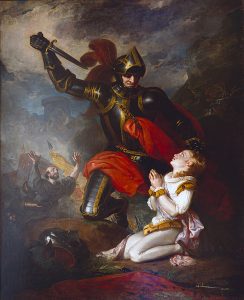
While this battaill was in fightyng, a prieste called sir Robert Aspall, chappelain and schole master to the yong erle of Rutland ii. sonne to the aboue named duke of Yorke, scace of y age of .xii. yeres, a faire gētlemā, and a maydenlike person, perceiuyng y• flight was more sauegard, then ariyng, bothe for him and his master, secretly conueyed therle out of y• felde, by the lord Cliffordes bande, toward the towne, but or he coulde enter into a house, he was by the sayd lord Clifford espied, folowed, and taken, and by reson of his apparell, demaunded what he was. The yōg gentelman dismaied, had not a word to speake, but kneled on his knees imploryng mercy, and desiryng grace, both with holding vp his hādes and making dolorous countinance, for his speache was gone for feare. Saue him sayde his Chappelein, for he is a princes sonne, and perad∣uenture may do you good hereafter. With that word, the lord Clifford marked him and sayde: by Gods blode, thy father slew myne, and so wil I do the and all thy kyn, and with that woord, stacke the erle to ye hart with his dagger, and bad his Chappeleyn bere the erles mother & brother worde what he had done, and sayde.
In this acte the lord Clyfford was accompted a tyraunt, and no gentelman, for the propertie of the Lyon, which is a furious and an vnreasonable beaste, is to be cruell to them that withstande hym, and gentle to such as prostrate or humiliate them selfes before him. Yet this cruell Clifforde, & deadly bloudsupper not content with this homicyde, or chyldkillyng, came to y• place wher the dead corps of the duke of Yorke lay, and caused his head to be stryken of, and set on it a croune of paper, & so fixed it on a pole, & presented it to the Quene, not lyeng farre farre from the felde, in great despite, and much derision, saiyng: Madame, your warre is done, here is your kinges raunsome, at which present, was much ioy, and great reioysing, but many laughed then, that sore lamented after, as the Quene her self, and her sonne: And many were glad then of other mēs deaths, not knowing that their awne were nere at hande, as the lord Clifford, and other.
But surely, mans nature is so frayle, that thinges passed be sone for∣gotten, and mischiefes to come, be not forsene. After this victory by ye Quene and her parte obteyned, she caused the erle of Salisbury, with all the other prisoners, to bee sente to Pomfret, and there to bee behedded, and sent all their heddes, and the dukes head of Yorke, to be set vpon poles, ouer the gate of the citie of Yorke, in despite of them, and their lignage: whose chyldren shortly reuenged their fathers querell, both to the Quenes extreme perdicion, and the vtter vndoynge of her husband and sonne. This ende had the valeant lord, Rychard Plantagenet, duke of Yorke, & this fyne ensued of his to much hardines
Comment
Edward Hall’s account was written in the 16th century. It is by far the most detailed account of the battle. His sources of information are not fully known. He lists many who fought on each side in the battle, largely confirming names given in previous accounts but also adding several, including some people who are proven to have been far from Wakefield. His account states that the Duke of York perished in the fighting on plain ground between his castle, Sandal, and Wakefield. He died ‘manfully fighting’ after leading his men onto the plain. Hall’s account states that 2800 died on the Yorkist side, plus a number of named nobles and knights. The Earl of Salisbury was captured along with other men and later beheaded at Pontefract. The heads of the deceased Yorkist leaders were set upon poles over the gates of the City of York.
Edward Hall, writing in Henry VII’s reign, had his work published posthumously in 1548. He had access to many people who may have heard accounts, from both sides. This may have included accounts relating to his ancestor, Sir David Hall, who fought and died at Wakefield. However, Hall would not conceivably have had access to anybody who had fought in or witnessed the battle. His account may have been influenced by rapproachment between the various factions.
The Earl of Rutland’s demise?
Hall was the first commentor to suggest that the Earl of Rutland was slain without mercy by Lord Clifford. The account suggests that the Earl of Rutland was a 12 year old boy. He was not, he was 17. Further, it says that he was pleading for mercy, on his knees, with his chapelain also pleading on his behalf. After portraying the Earl as being a defenceless boy, Hall goes on to state that Lord Clifford stated ‘by Gods blode, thy father slew myne, and so wil I do the and all thy kyn‘. After this, he is said to have ‘stacke the erle to ye hart with his dagger’, ie stabbed him in the heart. The ‘cruel’ Lord Clifford was then described as a childkiller before Hall states that it was Lord Clifford who was responsible for striking the head off the corpse of the Duke of York, placing a paper crown upon it, and presenting it Queen Margaret.
No earlier account suggested that the Earl of Rutland had been killed in this manner. Nor do previous accounts suggest that Edmund, Earl of Rutland was a child. At 17 he was of an age at which military service was perfectly acceptable. However, this version of events has to a degree been popularised despite Hall having made several factual errors: ie the Earl’s age and the Queen’s presence at Wakefield.
Links about the Battle of Wakefield
Dockray, Keith. The Battle of Wakefield and the Wars of the Roses. 21 page article on the evidence. Via the Richard III Society.
Peterson, Noah Gene. THE RHETORIC OF YORKIST POLITICAL WRITING DURING THE WARS OF THE ROSES. PhD Thesis.
Schoolshisyory. The Battle of Wakefield, 1460.
Featured Image
Plate 2.11 of Vetusta Monumenta depicts Sandal Castle as it appeared in the sixteenth century. Engraving by George Vertue after a drawing originally produced for a survey of the properties of the Duchy of Lancaster conducted by the Chancellor of the Duchy, Ambrose Cave, in 1561. Via Scalar.