
Henry Holland was born in the Tower of London on 27 June 1430 and drowned in September 1475 whilst sailing with the King’s party returning from the ‘invasion’ of France. Though from a staunchly Lancastrian background, Henry Holland Duke of Exeter, married Anne of York, a sister of King Edward IV. He was heavily involved in the events and unrest that preceded the Wars of the Roses, and an active participant in the conflict itself. His death at sea is strongly suspected to have been the result of foul play.
Henry Holland’s family background
Henry was the son and heir of John Holland, 2nd Duke of Exeter and Lady Anne (Stafford). His paternal grandfather was John Holland, half brother to King Richard II and the 1st Duke of Exeter in it’s first creation.
Marriage Union of Henry Holland and Anne of York
As a consequence of having a young King [Henry VI] who was not yet a father, the great families of England in the early 1440s began to double down on any claims that they may have in the event of a succession crisis. One outcome of this was the marriage of Henry Holland to Anne of York. Henry was heir to the Duchy of Exeter. He had blood ties to the Lancastrian crown but also stood to inherit a Duchy that had a relatively low income. Anne was a daughter of the Duke and Duchess of York. The Duke of York also had a blood tie to the King and a potential claim to the throne in the event of the King dying before prodicing a male heir.
The arrangement of a marriage stood to benefit both parties. The Duke of Exeter could tie in heir to the wealth of the Duke of York’s family and its affinities within court. The Duke of York gained a son in law with a blood bond to the Lancastrian line but who could also be moulded into a firm ally. Therefore a dynastic union of Henry and Anne was of benefit to both parties. The marriage was arranged in 1445 and the union concluded in January of 1446.
Henry Holland, Duke of Exeter
When John Holland Duke of Exeter died the following year, the new Duke, Henry Holland, was still a minor. He was placed in the care of his father-in-law, the Duke of York. This, in theory, would strengthen the bond of affinity between the senior Duke [York] and the new Duke of Exeter.
Henry Holland’s Inheritance
Despite inheriting his fathers title and becoming Duke of Exeter, Henry Holland had immediate financial concerns. His fathers Duchy was not a wealthy one and in part remained held in Dower by the young Dukes stepmother. There had been a large figure of 4500 marks due to be paid to his father as part of the marriage contract by the Duke of York – but if this was paid, it seems not to have formed part of Henry’s inheritance. As a result, the young Duke sought to enhance his landholdings and sought other streams of income.
Rash, Reckless and Violent: Henry Holland Duke of Exeter in the early 1450s
Having been given Livery of his title and estates in 1450, the Duke of Exeter made some improvements to his financial standing soon after. Some land settlements were made in 1450 in respect of lands in Somerset and Dorset. It followed in 1451 with some lands in Cornwall.
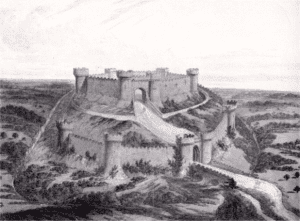
Henry then inherited some 8 manors from a cousin later in 1451. This parcel of lands was situated in Bedfordshire. The Duke of Exeter sought to increase this landholding, through use of false charges of treason against Lord Cromwell, who held adjoining lands including Ampthill Castle. Alongside making false claims, he took possession of lands by force. This led to heated debates and legal actions at Westminster. Locally, the Duke of Exeter’s methods led to nobody acting as Sheriff of Bedfordshire which prevented Lord Cromwell from having matters found in his favour.
The Crown intervened to try and rein in the young Duke. He was held in a bond of recognisance of 4000 marks. A figure that he would be unable to pay to the Crown should he be found to be in breach. Henry Holland had already taken steps that would inevitably see him being found in breach of the judgement against him. He had sided with Thomas Percy Lord Egremont in other land disputes. And in doing so, he was now aligned in a regional struggle [largely in Yorkshire and the North East] alongside the Percy family in opposition to the the Neville family.
As national politics altered rapidly, this perhaps inadvertently, allied the Duke of Exeter with the family who became his father-in-laws closest political and military allies. Through a bullish and violent approach to land holding, Henry Holland gained a reputation for unruly and intolerable actions.
Incapacity of King Henry VI and the Protectorship
When King Henry VI fell into incapacity in 1453, it became clear that a Protector would be needed to take charge of English government in the interim. The Duke of York was appointed to that position in early 1454. He was accompanied on the new Council by the Earl of Salisbury as Chancellor, and with Lord Cromwell added to the Council. This placed the Duke of Exeter in a scenario where his opponents in land disputes were in the most senior positions of government. His response was further aggression. At Spofforth in May of 1454 Henry Holland rose in revolt. It was a shortlived revolt. Henry was soon in the custody of the Yorkist dominated Council, and was imprisoned by them on 23 July 1454.
The Duke of Exeter’s ongoing clashes with other senior magnates
Henry Holland was released from captivity in March 1455 following the resumption of personal rule by King Henry VI. His freedom was not to last long, for the Yorkists returned him to captivity upon their resumption of control in the aftermath of the First Battle of St. Albans. He was kept safely in Wallingford Castle, being released after the death of Lord Cromwell, which prevented him from having to face further legal actions resultant from his earlier actions at Ampthill Castle. His periods in custody did not act as a long lasting deterrent to his aggression though. In 1458 he attempted to seize control of Warwick which, having failed, saw him once more placed under supervision and bound by recognisances [of £10000].
Henry Holland Duke of Exeter at War: 1459 – 1461
Despite the ongoing problems that Henry Holland Duke of Exeter had been having in relation to land disputes with senior Yorkists, he had not given any particular indication that he was firmly committed politically on a national scale. This changed in 1459. The Duke of Exeter was formly in the Lancastrian Camp from this point onwards, being present on the losing side at the Battles of Blore Heath and Northampton. He then went north with Queen Margaret and was with her treating with the Scots prior to the Lancastrian descent on London. He was at the Second Battle of St. Albans and one of the senior Lancastrians who managed to escape from the slaughter at Towton. From Towton, the Duke went north. He was one of the Lancastrian commanders who assaulted Carlisle in May of 1461, from where he eventually made his way to north Wales to aid in resistance to the Yorkist regime there. He, alongside Jasper Tudor Earl of Pembroke, led a force that was defeated at Twt Hill in October 1461. Again, he was able to escape his foes, eventually finding his way to France where he was part of Queen Margaret’s Court in exile until 1471.
The Readeption and the the Yorkist restoration
When King Henry VI was restored to the throne in the Readeption the Duke of Exeter was one of the senior Lancastrians who returned to England from exile. The revival of Lancastrian fortunes was not to last long though. Having fled in 1470, Edward IV invaded in spring of 1471. The Duke of Exeter was one of the commanders in the force defeated at Barnet in April 1471. At Barnet, Henry Holland was left for dead on the battlefield. He had, in fact, survived, and made his way to London where he sought sanctuary. Following the Yorkist victory at Tewkesbury in early May 1471 and the death of King Henry VI in the Tower of London in the same month, Holland was taken out of sanctuary and placed in the Tower of London as a prisoner. Unlike the Lancastrian nobles who had been captured at Tewkesbury, the Duke of Exeter was not to face trial and execution: quite possibly because the Duke was still married to Anne of York, a sister of King Edward IV.
Divorce
In November 1472, Anne of York secured a divorce from Henry Holland. Since the Duke of Exeter’s attainder in 1461 she had been the beneficiary of most of his estates as she had remained loyal to her brother, King Edward IV. After the resturn to power of her brother in 1471, she was able to convince the Crown and Church of her case for bringing an end to her union with Henry.
Death of Henry Holland 3rd Duke of Exeter
The Duke of Exeter was released from custody as Edward IV and his Council prepared for the invasion of France. He was to join the King’s army on the venture, which may have been perceived as a means of easing Henry into Court circles. On the return voyage from the French expedition, Henry Holland 3rd Duke of Exeter drowned. The circumstances in which he entered the sea and lost his life are far from clear. Foul play cannot be ruled out as the Duke had angered many people over the previous 20 years.
Henry Holland Duke of Exeter Links
Oxford Dictionary of National Biography – Biography of Henry Holland written by Professor Michael Hicks.
Sanctuary Seekers – Dr. Shannon McSheffrey on The Saga of Henry Holland: Sanctuary and the Wars of the Roses.
Featured Image
Street Banner depicting Henry Holland 3rd Duke of Exeter’s coat of arms. Barnet Museum via the Heraldry Society.