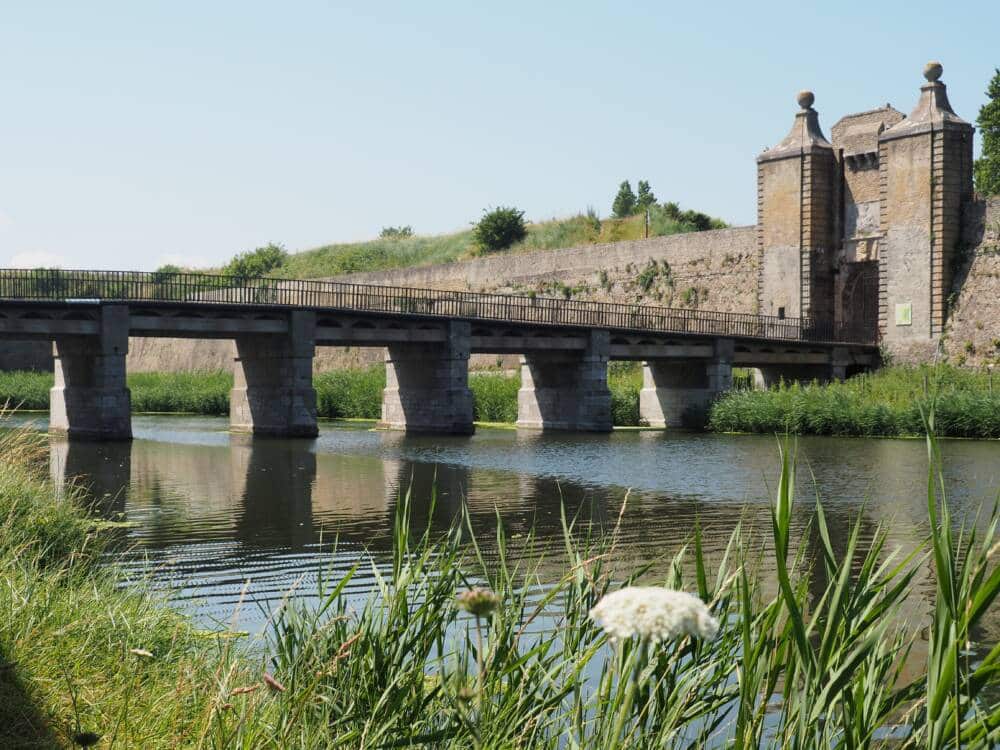
At Newnham Bridge, in English held lands of the Calais Pale, a clash took place on 23 April 1460 between Yorkists holding the port and fortified town of Calais and Lancastrian forces aiming to force entry.
Little is known about the clash that took place at Newnham Bridge on St. George’s Day, 1460. There are scarce references to it within contemporary or near contemporary documents: It is noted in Annales, and there is a non specific suggestion in Abbot Whethamstede’s Register.
Newnham Bridge
The Port and Town of Calais was defended by a series of natural and man made obstacles that made land based assaults difficult. An inland causeway ran from Gravelines to the north east of Calais to Newnham Bridge to the south west. Effectively this rendered the Port of Calais an island with a major point of entry being via Newnham Bridge. Further fortifications of note were those at Hammes and Guisnes. These were to the south of Calais and Newnham Bridge and acted, usually, as outlying defences against any incursions into the Pale of Calais from the Picardy region of France.
1460
Following the Yorkist force fleeing at Ludford Bridge, the Earls of March, Salisbury and Warwick had made their way to Calais. The Earl of Warwick had held command of the port prior to the events of late 1459 and retained control there. This was in the face of opposition. The Coventry ‘Parliament of Devils’ had attainted the Earl, with the King having already stripped him of his role in Calais and awarded it to Henry Beaufort Duke of Somerset.
As a result, the Duke of Somerset made efforts to seize control of Calais. His forces had by April 1460 taken control of the outlying fortifications at Hammes and Guisnes. Attempts were being made to sent the Duke reenforcements: thwarted by the Yorkist raid on Sandwich. The ongoing success of the Yorkists in controlling the English Channel and failures to make serious headway in relation to seizing control left the Duke of Somerset pressured to force the situation.
Henry Beaufort’s attempt to seize Calais
9 October 1459 – King Henry VI appointed Henry Beaufort Duke of Somerset as Captain of Calais. This stripped Richard Neville Earl of Warwick of the role. However, Calais was manned by men loyal to the Earl of Warwick, so the appointment could be, and was, challenged.
12-13 October 1459 – Rout of the Yorkists at Ludford Bridge. The Earls of March, Salisbury, and Warwick took flight to Calais.
20 November 1459 – Attainder of Yorkists including the Duke of York and Earls of March, Salisbury and Warwick.
November 1459 – Henry Beaufort Duke of Somerset sailed to the Pale of Calais. He failed to take control of the Port, it being under the control of Lord Fauconberg, a member of the Neville family. The Duke’s forces were successful in taking control of Guines.
15 January 1460 – Raid on Sandwich. A Yorkist flotilla sailed from Calais and attacked Lancastrian ships at Sandwich which were preparing to sail in support of the Duke of Somerset. Baron Rivers, his wife Jaquetta of Luxemburg, and their son Anthony Woodville were taken prisoner. A number of ships were seized or damaged by the Yorkists.
Funds, Soldiers, Desperation
The Duke of Somerset’s attempts to wrestle control of Calais from the Yorkists were seriously hampered by the Yorkists. The Raid on Sandwich deprived the Duke of much needed reenforcement. The Yorkist domination of the English Channel presented problems sending supplies, or attempting another fleet in support of Henry Beaufort’s efforts. Lack of funds for the continuation of the Lancastrian operations around Calais can also be noted: Lord Roos sailed back to England and pleaded for funds. These, and perhaps personal frustration, piled pressure on the Duke of Somerset. His prolonged absence from England may also have been a concern for him, or the Queen.
Newnham Bridge, 23 April 1460
On 23 April 1460 the Lancastrians launched an attack at Newnham Bridge. Details of the clash are patchy. In Annales the clash is described briefly as being between Calais and Guisnes, with heavy losses for the Duke of Somerset’s force. Elsewhere, Abbot Whethamstede notes that a force led by Lord Audley and Humphrey Stafford were forced to retreat due to weather. Other sources that would usually refer to actions in Calais are silent on this clash. There is no mention of it in the Paston Letters, which had documented the aftermath of the Raid on Sandwich, nor in chronicles of the day.
What can be surmised then is that an assault took place. That it failed. And that the Lancastrians incurred losses whilst possibly being hindered by poor weather. The nature of the attack is not known. It may have been as simple as an attempt to rush the entry point into Calais, or a more substantial force being repelled.
Did Edward then Earl of March fight at Newnham Bridge?
It is sometimes suggested in online groups that this may have been the first taste of battle for Edward, then Earl of March. As he is not named in any contemporary sources as having been involved, but is known to have been at Calais at the time, this is conjecture. Similarly, there is no specific reference to the Earl of Salisbury participating, nor other leading Yorkists such as Fauconberg [The Earl of Warwick was not in Calais on this date]. Similarly there is no direct reference to Henry Beaufort being present at the engagement. Only Lord Audley and Humphrey Stafford are named in contemporary accounts. No senior noble of either side died in the clash, and the only hint as to the scale of the fighting is the suggestion in Annales that the Lancastrians lost many men.
Annales
Et Henricus Somerset, existcns apud Guynes, habuit multos et diverses conflictus cum illis de Calisia inter Caleys ct Gynys. Sed in festo Sancti Georgii dux Somerset perdidit multos de suis propc Newubam Brigge.
Translation
And Henry Somerset, being at Guynes, had many and diverse conflicts with them about Calais between Calais and Guynes. But on the feast of St. George Duke Somerset lost many of his men near Newembridge.
Source: Stevenson, J [ed].Letters and papers illustrative of the wars of the English in France during the reign of Henry the Sixth, King of England. Page 772.
Note: Annales is often noted as being authored by William Worcester but his penning of it is far from certain.
Image
Citadel at Calais, via Calais Tourism