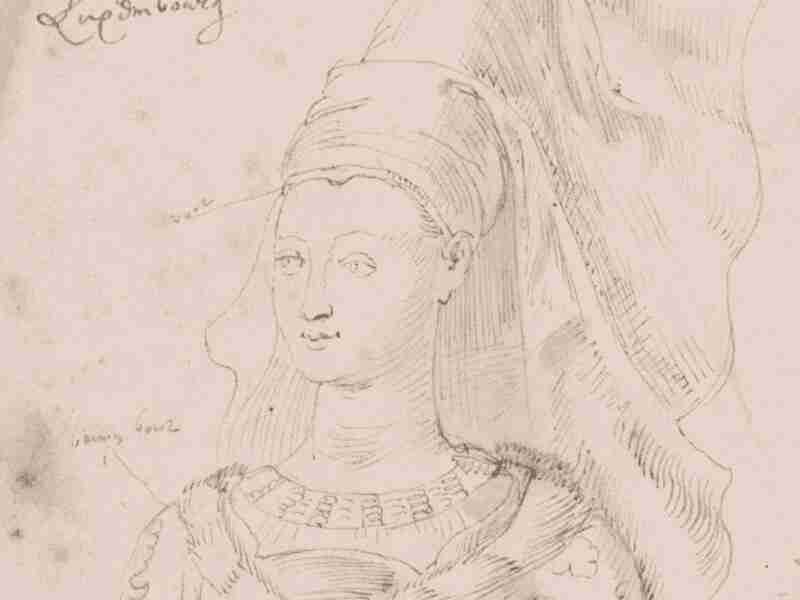
Jacquetta of Luxembourg [1416 – 1472]. Daughter of Peter of Luxembourg, Count of Saint-Pol and Brienne, and Margaret of Baux. Her family ties led, in 1433, to her marriage to John Duke of Bedford. Following the Duke’s death Jacquetta remarried, without the King’s consent, to Sir Richard Woodville. The marriage resulted in 14 children, including Elizabeth, Queen Consort to Edward IV. Jacquetta of Luxembourg remained influential until her death, in 1472.
Birth and childhood of Jacquetta of Luxembourg
Little is known of the childhood of Jacquetta of Luxembourg. There is no firm evidence as to when, or where Jacquetta was born. It commonly believed that she was born in either 1415 or 1416. She was most probably raised at Brienne, seat of her family. Jacquetta was one of nine children of the Count of St Pol, Conversano, and Brienne and Margaret of Baux. The family was significant. They held and administered lands that fell under the sphere of influene of the Duchy of Burgundy. Jacquetta’s uncle, Louis of Luxembourg, was a senior cleric and administrator within France.
First Marriage, to John Duke of Bedford
Jacquetta of Luxembourg’s first marriage was to John Duke of Bedford. The Duke’s first wife, Anne of Burgundy, had recently died and a new diplomatic union was of merit. Jacquetta’s uncle Louis, bishop of Thérouanne, was well placed to advise the Duke of Bedford on Jacquetta’s suitability. Louis was also Governor of Paris and had been installed by John as Chancellor of France. This made him the de facto head of the administration of the Anglo-French Parlement in Paris.
The result was the then 17 year old Jacquetta of Luxembourg being married to the powerful Duke of Bedford. Though he was far older than her, it was a union which reiterated the bonds between the English and the House of Luxembourg, an important part of the diplomatic web that managed the Anglo-Burgundian control of France.
Jacquetta and John married at her uncles bishops palace at Thérouanne on 20 April 1433. It made Jacquetta of Luxembourg the Duchess of Bedford. This placed her as being the second highest rank woman in the English Court, behind the King’s mother, until the marriage of Henry VI to Margaret of Anjou in 1445.
A Wealthy Widow
John Duke of Bedford died on 14 September 1435, leaving Jacquetta of Luxembourg a widow at the age of 19. As was customary at the time, she retained her title as Duchess, and a Dower portion of the Duke’s wealth equivalent to one-third of his estates value. This meant that Jacquetta was wealthy and retained her high status within the English Court. These were confirmed by King Henry VI in February 1436, on the condition that she sought his consent for any future marriage.
Marrying without the King’s Consent, to Sir Richard Woodville
By March 1437, Jacquetta of Luxembourg had remarried, to Sir Richard Woodville. This marriage was undertaken without the Duchess of Bedford having asked for the consent of King Henry VI. As a result of the secretive union, the couple were required to pay a sum of £1000 to secure a Royal Pardon. This was a considerable amount of money at the time.
The Duchess had chosen to marry through choice, rather than allowing herself to be used for diplomatic purposes. This in itself was an issue at the time, as diplomatic marriages were of huge importance politically. Further to this, her choice of husband was questionable. Sir Richard Woodville was not from a noble family and was far beneath Jaquetta in terms of status and rank. It was very much a mismatch in terms of the expectations of court circles.
Sir Richard Woodville was known to Royal circles though. He had been a member of the Duke of Bedford’s household, having served under him in several capacities in France. He had been knighted in 1426 at the same time as Richard 3rd Duke of York.
Rise and Role of Jaquetta and the Woodville Family: 1437 – 1460
Following the marriage of Jacquetta and Sir Richard, the couple initially spent time in both France and England. Much of the Duchess of Bedford’s inheritance lay in English held lands in France. This required Jacquetta’s attendance to undertake legal duties relating to components of the estates. In 1440, the couple bought the Manor of Grafton, in Northamptonshire. It was to become the family home.
Between 1437 and 1458 the couple had 14 children. This included Elizabeth Woodville, future Queen to King Edward IV. Jacquetta of Luxembourg retained links to court. In 1444 the Duchess of Bedford was one of the senior courtiers to accompany Margaret of Anjou from France for her marriage to King Henry VI. Throughout the period to 1460, Jacquetta remained an important, and senior, figure within the Lancastrian Court.
Sir Richard Woodville continued his administrative and military roles. These and his marriage to Jacquetta saw him elevated to the rank of Baron, with him being created Baron Rivers on 9 May 1448 and installed as a Knight of the Garter in 1450. The Woodville Family was therefore of note within the reign of King Henry VI, long before the outbreak of the Wars of the Roses.
Jaquetta Duchess of Bedford and the Yorkist Regime 1461 – 1464
A senior and loyal Lancastrian Lady, Jacquetta was in London as the Lancastrian army of Queen Margaret approached in February 1461. The city authorities asked Jacquetta to negotiate on their behalf with Margaret of Anjou, which the Duchess did with other senior noblewomen and some clerics.
Jacquetta of Luxembourg then saw the Yorkists proclaim Edward of York as King Edward IV, and the departure of Yorkist armies for the campaign that culminated in victory at Towton. The Yorkist victory had the potential to significantly impact upon the fortunes of Jacquetta and Richard. The Duchess of Bedford was very clearly a senior Lancastrian. Lord Rivers and his son Anthony had fought for King Henry VI at Towton.
The change of regime did not result in the Woodville family being attainted. Richard and Anthony were permitted to submit to the new regime and were employed as part of the Yorkist effort to oust Lancastrian rebels from the north. Jacquetta’s status as Duchess of Bedford possibly influenced the Yorkist approach to the family. Whilst her Dower was suspended, her husband Lord Rivers was appointed to the Royal Council in 1463.
Allegiances Changed: Jacquetta as the Queen’s Mother
In 1464 Elizabeth, eldest daughter of Jacquetta and Richard, married King Edward IV in a secret ceremony. When King Edward IV made the union known, it immediately raised the profile of the whole Woodville family. Jacquetta Duchess of Bedford was clearly used to being a senior figure at court. Lord Rivers, already a Royal Council member, was appointed as Lord Treasurer in 1466, elevated to the rank of Earl in the same year, then made Constable of England in 1467.
Jacquetta, along with her daughter the Queen, and Earl Rivers, were able to advance the Woodville family as a result of their new position. A series of marriages for the Queen’s siblings were arranged, all to people of high status. Other forms of patronage included ecclesiastical and administrative appointments for members of the family. The union of Elizabeth to King Edward also saw the Dower payments to Jacquetta restored in 1465: they had been suspended in 1461.
The Duchess of Bedford participated in Court life. In particular, she was present at key events relating to her daughter, the Queen. Jacquetta had a role at Elizabeth’s Coronation in 1465 and took part in Elizabeth’s Churching in 1466 following the birth of Princess Elizabeth.
When the readeption happened, Jacquetta joined her daughter in taking up Sanctuary in Westminster Abbey. By this time, her affiliation was clearly seen as being with the House of York, despite her rank and title being derived from her first marriage, to a Royal Duke of the House of Lancaster.
Allegations of Witchcraft against Jacquetta Duchess of Bedford
Jacquetta Duchess of Bedford was formally accused of Witchcraft by Thomas Wake. These accusations resulted in the Council hearing evidence of the Duchesses alleged witchcraft.
Wake, an esquire in the employment of Richard Neville Earl of Warwick, produced lead figurines that had been broken in the middle and held together with wire. The figure had initially been handed to a parish clerk by Harry Kyngeston who had discovered them after soldiers had visited his home. The Clerk, John Daunger, was willing to testify that the figurines had been made by Jacquetta Duchess of Bedford in the image of the King’s family.
The implication of this being that they were used for the practice of witchcraft and were evidence of the Duchess using sorcery to bring about the King marrying Elizaabeth Woodville.
These charges were dismissed by Council on 19 January 1470. The case had been brought during King Edward IV’s period of confinement in Middleham Castle, and was effectively dismissed as soon as he returned to personal rule with the confirmation of that coming in January 1470.
Accusations of witchcraft and sorcery by the Duchess of Bedford were one of the methods utilised by the Earl of Warwick to discredit the Woodville family. The same accusation was posthumously levelled at the Duchess in 1483 as the legitimacy of the marriage of Elizabeth Woodville and King Edward IV was debated after the King’s death.
The allegation of Witchcraft came shortly after the execution, on the Earl of Warwick’s orders, of Earl Rivers and John Woodville. Having dispensed with two of the senior Woodville men through extra-judicial means, the Duchess was targetted through these charges.
Death of Jacquetta of Luxembourg
Jacquetta of Luxembourg Duchess of Bedford died aged 56 at Grafton on 30 May 1472. Her place of burial is not known.
Links: Jacquetta of Luxembourg, Duchess of Bedford and Countess Rivers
Oxford Dictionary of National Biography – detailed biography of Jacquetta Duchess of Bedford.
Conor Byrne Historian – article about Jacquetta that notes some of the errors in The White Queen.
Featured Image
17th century sketch by Peter Paul Rubens labeled as Jacquetta (Jacqueline) of Luxembourg. Via Wikimedia.
