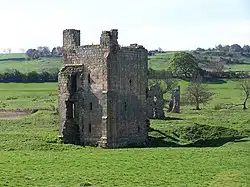
Ravensworth Castle, North Yorkshire, was built for Henry, 3rd Lord Fitzhugh in the late 14th century. Ravensworth is also home to a walled hunting park, for which a licence was granted in 1391. The Fitzhugh family were significant throughout the 15th century, with close ties to Royalty and major noble families.
Ravensworth Castle
Ravensworth Castle was a 3 storey tower built on a motte. It had a gateway to the north eastern corner of the tower which accomodated a portcullis and was furnished with loopholes. Alongside the gatehouse was a tower reinforced with double buttresses and with loopholes incorporated into each storey.
Attached to the tower was a curtain wall which extended outwards arcing from the south east to south west of the castle. The foundations of two towers remain on this curtain wall. Alongside the curtain wall was a chapel with an attached belfy tower. To the north west of the main tower was a stable block which was quite sizeable.
Perhaps unusually the motte is situated at the end of the castle that the entrance was at. Ravensworth was approachable only from the north west due to the marshland. Typically a motte would be located furthest away from the main access point, not adjacent to it. Furthermore, the land to the northern side was higher than that upon which the castle was built which is not typical of defensive sites of the period or location. [Though some such as Bolton Castle shared this peculiarity]
To seperate the motte from the bailey area a ditch was dug, adding extra defensive strength to the tower.
The site in total is 137 metres long and has a maximum width of 67 metres.
The hunting park, licensed in 1391, was surrounded by a 2 metre high wall, much of which remains intact. The park had a gatehouse which was two storeys high and appears to have offered accomodation.
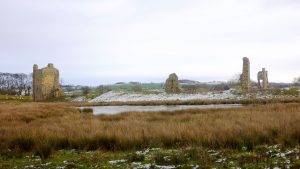
Beyond the walls of the castle a village was sited to the north. This has long since been abandoned but its outline is discernable from aerial photographs. Much of the land to the east and west of the castle is marshland, acting as a natural moat. To the west of the castle this was managed in the medieval age to create a lake which had defensive and economic uses.

The FitzHugh Barons of Ravensworth
Henry FitzHugh, 1st Baron Fitzhugh died in 1356.
The 2nd Baron Fitzhugh, Hugh, married Joan Scrope, a daughter of Henry Scrope, 1st Baron Scrope of Masham. This family link would prove important in future generations. Hugh Fiztroy, 2nd Baron Fitzroy, died in 1386.
Henry FitzHugh 3rd Baron FitzHugh of Ravensworth
Henry FitzHugh, 3rd Baron Fitzhugh, was the man for whom Ravensworth Castle was built. Henry was a prominent noble, serving the Crown as a soldier and administrator on numerous occasions. He was first summoned to Parliament as a Baron in 1388. Shortly afterwards he was involved in Anglo-Scottish diplomatic negotiations and, when these failed, he fought in the Battle of Humbleton Hill [1402]. The 3rd Baron Fitzhugh was soon involved in other diplomatic service. This time it utilised his family ties. In 1405 Henry negotiated with his uncle, Richard Scrope Archbishop of York which resulted in the latters surrender to the crown.
The following year when Princess Philippa travelled to Denmark to marry King Eric of Pomenaria, Henry 3rd Baron FitzHugh was one of the escorts appointed to travel with the Royal party. Whilst in Denmark he visited Brigstana Abbey and agreed to assist the community in their efforts to open a Bridgettine institution in England. For this he donated one of his manors, Cherry Hinton. The ultimate result of the offer to assist the religious community was the opening of Syon Abbey which was patronised by King Henry V as well as nobles including the 3rd Baron FitzHugh.
Henry 3rd Baron FitzHugh was appointed as a Knight of the Garter by King Henry IV in 1409.
Under King Henry V, Henry 3rd Baron Fitzhugh’s importance grew. He acted as Lord Constable at the new king’s coronation. Soon after he was appointed as Chamberlain of the Household, a position he held until his death in 1425, during the reign of King Henry VI. The baron participated in the 1415 invasion of northern France and fought at Agincourt. Upon his return to England he was, in 1416, appointed as Treasurer of England, a role he held until 1421. Whilst holding the concurrent roles of Chamberlain of the Household and Treasurer of England, the 3rd Baron Fitzhugh continued to be utilised as a diplomat. He was one of the leading figures involved in Anglo-French negotiations that culminated in the Treaty of Troyes in 1420.
Henry 3rd Baron FitzHenry FitzHugh, 5th Baron FitzHughHugh was in France when King Henry V died. As a senior official he was entrusted with accompanying the king’s remains on its journey to England. Henry 3rd Baron FitzHugh died in January 1425 and was buried at Jervaux Abbey.
William 4th Baron FitzHugh of Ravensworth
William Fitzhugh inherited his fathers title and estates in 1425 and held them until his own death in 1452. He attended Parliaments as a Baron but was not as notable as his father had been in terms of offices held.
Henry FitzHugh, 5th Baron FitzHugh of Ravensworth
Henry FitzHugh 1429-1472 is a curious example of how affinities and loyalties could and did change during the turblence of the Percy-Neville feud and the onset of the Wars of the Roses.
Henry married Lady Alice Neville, the third daughter of Richard Neville 5th Earl of Salisbury and therefore a sister of Richard Neville 16th Earl of Warwick. This formed a very close bond with the Neville’s of Middleham. He was also related to the Scrope’s of Masham who were closely aligned to the Percy family.
Percy-Neville Feud
As tension rose in the North, Lord FitzHugh was close to his wifes family. Henry 5th Baron FitzHugh was present in the Neville contingent that marched on Topcliffe in 1453. This followed a pattern of FitzHugh support for the Neville cause, his father had been retained by the Earl of Salisbury. On the whole though, it seems that Henry 5th Baron FitzHugh avoided direct participation in the clashes between the two more powerful families in the region.
Coventry Parliament, 1459
That lack of direct involvement in the clashes led, in 1459, to Henry 5th Baron FitzHugh being granted stewardships of properties in Richmondshire that the Coventry Parliament stripped from the Earl of Salisbury. This included Middleham Castle. What is perhaps peculiar here is that despite having such close family ties to the Neville family and having been at their side at Topcliffe in 1453, Henry 5th Baron FitzHugh had attended the Parliament at Coventry. Furthermore, he had been one of the peers who attainted his kin. Perhaps this was simple pragmatism, the Earls of Salisbury and Warwick had been routed at Ludford and forced to flee the country. In attending Parliament and swearing an Oath of allegience to King Henry VI, was he was simply protecting his interests and making the most of an unwanted situation?
Wakefield and Towton
The 5th Baron FitzHugh may have felt he had little choice in 1459 but it was a choice of sides that he stuck to as events of 1460 and 1461 saw further bloodshed. The return of the Duke of York and Earls of Salisbury and Warwick offered an opportunity to realign with his kin. He chose not to. When the Act of Accord led to the assembling of a large Lancastrian force in the north, Henry 5th Baron FitzHugh was among those men. As a result, he was among those arrayed for the Battle of Wakefield, and later at Towton, though it is not entirely clear what involvement he had, if any, in the fighting in either battle.
Reconciled with the Yorkist Regime and his Neville Kin
Following the Yorkist victory at Towton, Henry 5th Baron FitzHugh of Ravensworth soon made his peace with the new regime and his wifes family. He was not attainted, nor does he appear to have been subjected to any fines or lesser punishments. It has been suggested in some articles that his short affiliation to the Lancastrians was to some extent stage managed – see Pollard’s book on the North East of England in the period. What is clear is that he was once again undertaking administrative roles in the region and continued to be summoned to Parliaments.
1470 and FitzHugh’s Yorkshire Revolt
The period 1469-1471 saw the Crown change hands twice and Edward IV briefly in the captivity of the Earl of Warwick and Duke of Clarence. The events of 1469 saw a series of rebellions in Yorkshire, one led by a ‘Robin of Redesdale’ in April followed by a further uprising led by ‘Robin of Holderness’. The FitzHugh family appear to have been involved in these insurrections. In his article, The Yorkshire Rebellions of 1469, Keith Dockray notes that a son of the 5th Baron FizHugh, also called Henry, along with Sir Henry Neville, were primary instigators of these revolts. The extent to which either man was responsible is a matter of debate as there are numerous theories as to who organised the rebellions on behalf of the Earl of Warwick.
What is clear is that the 5th Baron Fitzhugh and Lady FitzHugh were the main organisers of the revolts of 1470. This revolt set out to force King Edward IV into action in the North of England, to coincide with the landing of the Earl of Warwick and Duke of Clarence on the south coast. It is described in depth in Lord Fitz Hugh’s Rising in 1470 by A. J. Pollard [Access required]. In brief, in 1465 Henry FitzHugh had been fully reintegrated into the Neville system of retaining in the north. Henry was reappointed to administrative roles and as a Justice. Then he was appointed as Warwick’s deputy warden of the west march the following year with a sizeable salary for the role. As the Earl of Warwick planned his next move following the tumultous period in which Edward IV had briefly been in his custody, it was Henry 5th Baron FitzHugh, and his wife, Lady Alice [Neville], who were the masterminds of the uprising planned for Richmondshire. The rising in part led to Edward IV fleeing to Burgundy and the Readeption of King Henry VI.
Henry 5th Baron FitzHugh died in 1472.
Richard FitzHugh, 6th Baron FitzHugh of Ravensworth
Richard FitzHugh 6th Baron FitzHugh was retained by Richard duke of Gloucester. He was one of the five peers who accompanied the duke in the 1482 Invasion of Scotland. He was present at the Coronation of Richard III. When Richard III redistributed lands following the Buckingham Revolt, FitzHugh was one of the northern lords who benefitted, being granted some of the estates that had been confiscated as a result of the uprising. This resulted in Richard FitzHugh being appointed as a Commissioner of the Peace for Dorset in November 1484. He was also one of the peers who was appointed to the Council of the North when it was introduced by Richard III.
Under King Henry VII, Richard FitzHugh was given royal authorty to deal with insurrection and the threat of invasion from Scotland. He was assisted in this task by the restored Henry, Baron Clifford.
Ravensworth Castle, North Yorkshire Links
Historic England – Official Listing
Gatehouse Gazetteer – sources
Richardson, S., & Dennison, E. (2014). A wall with a view? The gardens at Ravensworth Castle, North Yorkshire. Landscape History, 35(2), 21–38.
Heritage Gateway – description of the site, it’s history a a summary of available sources.
‘Parishes: Kirkby Ravensworth‘, in A History of the County of York North Riding: Volume 1, ed. William Page( London, 1914), British History Online
Featured Image
Ravensworth Castle, North Yorkshire. Photo by David Martin – CC BY-SA 2.0 – via Wikimedia
