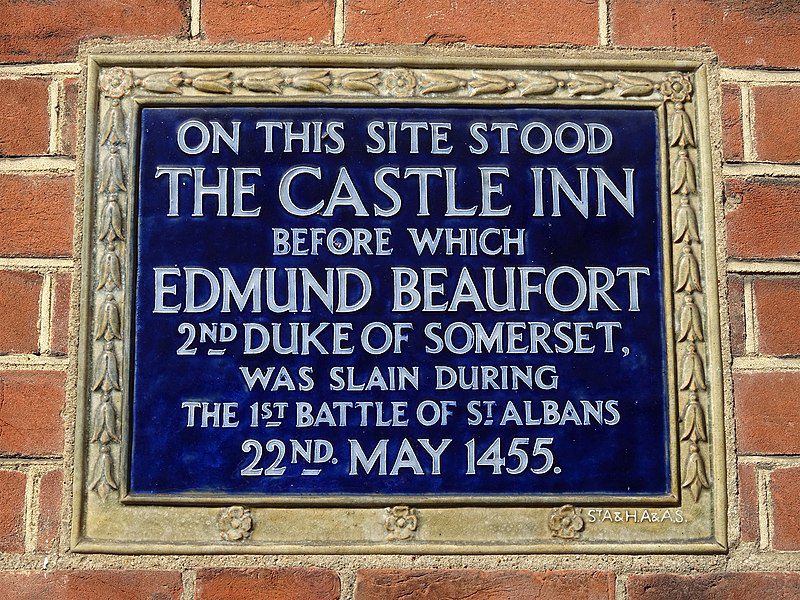
Edmund Beaufort was born in 1406 and died in the First Battle of St. Albans aged 49, in 1455. Edmund was the fourth son, fifth child, of John Beaufort 1st Earl of Somerset and his wife, Margaret Holland. A grandson of John of Gaunt, Edmund was a cousin of King Henry VI and Richard 3rd Duke of York. Despite being the 4th eldest son of the Earl of Somerset, Edmund was to become head of the Beaufort family. This followed the deaths of his eldest brother Henry 2nd Earl of Somerset at Rouen in 1419, the third born son, Thomas Count of Perche in 1431, and the second eldest son, John Beaufort 1st Duke of Beaufort, in 1444. As an administrator, soldier, and noble, Edmund Beaufort was influential, holding a variety of positions and commands which led to conflicts with the Duke of York, and later with the Earls of Salsibury and Warwick.
Edmund Beaufort’s Inheritance
Edmund’s elder brother, John, died in 1444. He had been created Duke of Somerset. John’s lands and wealth were inherited by his sole heir, his daughter, Margaret Beaufort. At the time of his death, John had fallen from grace, having overseen a failed campaign in France which had led to him being barred from attending the Royal Court. With John 1st Duke of Somerset’s death, the title was revoked and Edmund inherited the title of Earl of Somerset, as had been held by his father.
Prior to his brother’s death Edmund Beaufort had become a significant man in his own right. Serving in France and Normandy, he undertook a range of roles, some of which were resultant from his brother’s capture by the French. Perhaps most notable was Edmund’s leading of the defence of Calais in 1436. This led to Edmund being installed as a Knight of the Garter. He then oversaw a campaign in Normandy that was reasonably successful in retaking lands from the French. This included the recapture of Harfleur, which meant that the English once again retained two of the most important Channel ports. These successes saw the Crown create Edmund as Earl of Dorset, a rank from which he was subsequently elevated from, to Marquess, along with grants of lands and titles in the English controlled parts of France and Normandy [i].
Edmund Beaufort Duke of Somerset
Extract from Betrayal in the Wars of the Roses (Part One) by Dan Moorhouse.
Elevation of Edmund Beaufort
Edmund Beaufort, like his brother, had benefitted greatly from titles, lands, and patronage from King Henry VI. The same family ties and networks provided for him the political and military opportunities and powers that enabled his Earldom, elevation to Marquess, and the funds with which to engage in operations in France. So highly thought of was the Marquess of Dorset, that he was appointed to the hugely important positions of Lieutenant of France, Guyenne, and Normandy in late 1447. It was followed in March of 1448 with Edmund being created Duke of Somerset.
Fall of Normandy under Edmund Beaufort’s command
The positions were among the most important that could be given to an English noble. They enabled the Duke of Somerset to act in the king’s name within the occupied areas of France, and in Guyenne and Normandy. Unfortunately for Edmund Beaufort, he was granted the roles at a time when the English grip on these territories was under severe pressure. Under his stewardship Normandy was lost in August 1450. Bordeaux and Guyenne fell the following year, before being briefly recovered by the Earl of Shrewsbury before being lost again in 1453. The loss of France was the result of a wide range of factors, from governance by the King and his Council, through to funding, tactical inadequacies, French ingenuity, the continental alliance systems, and sheer bad luck. In a political setting, there was usually somebody who had to take the blame. This led to conflict between the Duke’s of Somerset and York.
See: William de la Pole and Adam Moleyns for examples of leading figures being impeached and/ or murdered at this time.
The Duke of Somerset’s Challenges
The Duke of Somerset’s actions in the period leading to the fall of Normandy were called into question. His behaviour and demands with respect to having to cede his lordship of Maine to the French as a result of the terms of the marriage contract drawn up between King Henry and Margaret of Anjou linked him to lords who, by the end of 1450, had been impeached, or murdered. Politically this was a difficult association. However, it was the way Edmund Beaufort defended Normandy that drew the attention of the Duke of York. Despite having large payments for ceding Maine, personal wealth, and funds from Council, he was accused of having done little to improve the defences of the Duchy of Normandy.
Fall of Normandy 1449/50
The collapse of English defences in Normandy was rapid. The French attacked in July 1449. Rouen was surrendered by the Duke of Somerset himself, in October 1449. The following July, Caen, and with it the whole of Normandy, was surrendered. The expectation at the time was that defenders of a besieged town would hold out until there was no option but to surrender, on honorable terms. This would require them to endure some degree of discomfort whilst opportunities for relief could be explored, forces gathered, attempts made. Rouen was handed to the French without the opportunity for that to happen. So too was Caen surrendered before a relief force could be sent from England. Defeat without honour was intolerable to many lords. Especially so those who were slighted by it: the Duke of York was nominally the Captain of Rouen; or those who lost estates in Normandy because of the French victories.
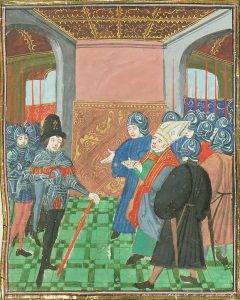

Deserved or not, the Duke of Somerset was accused of being responsible for the losses suffered in Normandy in particular. Fabyan recorded that:
“And thus began rumour’ & malyce to spryng atwene the lordes of th lande: and specially the duke of Somerset and other of the queues counsayll were hadde in great hateryd for the losynge of Normady, wherof [the] chief cytie Roan was lost or gyuen vp by appoyntement the yere preceding…[ii]”
1450-52: Cade, Dartford and the rise of factionalism
The charge that the Duke of Somerset was responsible for the loss of Normandy was part of a wider complaint about the conduct of Government. 1450 had seen the rebellion led by Jack Cade. That had noted a series of complaints about corruption, poor or wicked counsel, frivolous spending, and unfair taxes. Though the complaints of the commons were raised in revolt, they mirrored many of the concerns of some of the nobility. It led to the Duke of York, frustrated at lack of change and the favouritism within court, arraying his men and marching from his lands in the Welsh Marches, through the south, around London and then towards the capital. It resulted in a show of force by the Duke of York in 1452 that culminated in an armed standoff at Dartford against a force that included the King, Duke of Somerset, and Earls of Salisbury and Warwick amongst others.
When the two sides faced each other at Blackheath in 1452, the complaint made by the Duke of York was once again aimed at the Duke of Somerset. Fabyan’s account continues by noting that:
“…his [the Duke of York’s] entent & purpose was to remoue from hym a fewe euyll dysposyd persones, by whose meanys the comon people was gretiouslye oppressyd, and the comynaltye greatlye enpouerysshed; of the whiche he namyd for pryncypall the duke of Somerset.[iii]”
Political attack on the Duke of Somerset by the Duke of Norfolk
The dispute between the Duke of Somerset and Duke of York escalated further in 1453. The Duke of Norfolk, aligned to the Duke of York, petitioned for the arrest of Edmund Beaufort. He argued that:
“greete dishonneurs and losses that ben come to thys full noble royaume of England by the fals menes of som persones that have take on theym over grete autoritee in thys royaume shulde be knowen, and that the persones lyvyng that have doon theym shulde be corrected aftyr the merites of her desertes. And to that entent y have denounced and delyverd to you in wrytyng certeyn articles ayenst the Duc of Somerset, whych ys one of theym that ys gylty thereof.[iv]”
This renewed attack on the Duke was set against the context of Guyenne having also been lost to France, the King having entered his first period of incapacity, civil unrest between the Neville and Percy families in the north east, and critically with regards the Duke of Somerset, the transferring of affinity to the Yorkist faction of the Earls of Salisbury and Warwick due to inheritance disputes with the Duke of Somerset. The balance of power in court had shifted. The Duke of Somerset could not hide behind support from an incapacitated monarch, instead, he was placed in custody in the Tower of London. He remained there from late 1453 until February 1455[v], shortly after the King’s recovery.
Recovery of King Henry VI and the 1455 Great Council
The consequence of the King’s recovery and the Duke of Somerset’s release was an immediate change in the balance of power at court. Once more the Duke of Somerset was in the ascendancy as chief amongst the counsellors to the King and Queen. Having been detained for over a year, the Duke was slighted, and angry. A Great Council was called by the King. It was to be held in Leicester in May 1455.
The tension between the factions headed by Queen Margaret and Duke of Somerset and that led by the Duke of York were heightened. A Great Council in a city loyal to the court party could be taken as a sign that punitive action was about to be taken against the Yorkist lords. Those lords began raising their retainers. In response, the Duke of Somerset and other nobles of that faction raised their retinues. The King was therefore to be accompanied by a large force. It found its way to Leicester blocked by a Yorkist force at St. Albans.
The Yorkists once again made accusations about the Duke of Somerset. Messages were sent that were never passed to the King. Some survive. One letter reminds the King that the Duke of York and his affinity are true and loyal, concerned only for his welfare and that of the commons of England. It asks,
‘sayd Hyghnesse so to take, accept, and repute us [the Yorkists], and not to plese to geve trust or confidence unto the sinistrez, maliciouse, and fraudulent laboures and rapportes of our sayd ennemyes unto our comyng to your sayd moste noble presence[vi]’.
Death in the First Battle of St. Albans
The Yorkist lords became frustrated with the failings of negotiations. In 1452 the apparent success of Yorkists at forcing change at Blackheath had been almost immediately turned on its head by the Duke of Somerset, resulting in the Duke of York’s public humiliation. This wasn’t going to happen again, something that perhaps the Duke of Somerset had not contemplated. The result was the First Battle of St. Albans on 22 May 1455. Fought within the streets and squares of the town centre, it was a short but decisive battle. In which the Duke of Somerset, Edmund Beaufort, was killed.
Extract from Betrayal in the Wars of the Roses (Part One) by Dan Moorhouse.
[i] Richmond, Colin. “Beaufort, Edmund, first duke of Somerset (c. 1406–1455), magnate and soldier.” Oxford Dictionary of National Biography. 04. Oxford University Press. <https://www.oxforddnb.com/view/10.1093/ref:odnb/9780198614128.001.0001/odnb-9780198614128-e-1855>
[ii] Fabyan, p626
[iii] Fabyan, p627
[iv] Gairdner, James. Paston Letters (Volume II) Entry 230, The Duke of Norfolk’s Petition.
[v] The Duke of Somerset was released on bail on 5th February 1455. ‘Close Rolls, Henry VI: February 1455’, in Calendar of Close Rolls, Henry VI: Volume 6, 1454-1461, ed. C T Flower (London, 1947), p. 9. British History Online http://www.british-history.ac.uk/cal-close-rolls/hen6/vol6/p9 [accessed 28 June 2022].
[vi] Gairdner, James. Paston Letters (Volume 3) Letter 282, Memorial to Henry VI.
Featured Image
Plaque marking the spot where Edmund Beaufort Duke of Somerset was slain during the First Battle of St. Albans. Via Wikimedia. By Spudgun67. This file is licensed under the Creative Commons Attribution-Share Alike 4.0 International license.
.jpg)
Biography of Edmund Beaufort, Duke of Somerset, from the Dictionary of National Biography, 1885-1900, Volume 04
Beaufort, Edmund by Henry Avray Tipping
BEAUFORT, EDMUND (d. 1456), second Duke of Somerset, statesman and general, was the younger brother of Duke John, and excelled him in the brilliancy of his early military exploits. He held his first command in France in 1431, and nine years later he succeeded in recapturing Harfleur, the loss of which had shaken the English ascendency in Normandy. He was at once invested with the garter on the scene of his triumph. In 1442 he obtained the earldom of Dorset for having relieved Calais, and on his return home after a successful expedition into Anjou in conjunction with his future antagonist the Duke of York, he was raised to a marquisate. But on succeeding his brother in the Somerset titles (to the earldom in 1444 and the dukedom in 1448), though he gained in political influence, military success deserted him. The government had just recognised that England could not hope to permanently hold France as a conquered country, and sought an honourable peace. With this end in view they concluded a truce in 1444, and shortly afterwards married Henry VI to Margaret of Anjou, ceding Anjou and Maine, nominally to her father, really to Charles VII. This policy was wholly unpopular in England, where the warlike spirit remained in the ascendant; and the Duke of York, seizing the opportunity of Gloucester’s death to head the opposition to the court, was superseded in the lieutenancy of France by Somerset, whose uncle, Cardinal Beaufort, was chief minister. The truce was taken advantage of by the French to prepare for a final effort to drive the foreigner out, while the English ministers and commanders were especially engaged in swelling their private fortunes. On the one side patriotism, on the other love of plunder, led to frequent breaches of the truce, and removed more and more the prospect of a definitive peace. At length the commander of one of the English detachments, with the secret support of Somerset, surprised the town and castle of Fougères, and Somerset, who probably profited largely by the spoils, refused to give it up, or even exchange it. Hence in 1449 regular war recommenced, in which the English were completely overmatched. Their outposts fell rapidly into the hands of the French, who in October invested Rouen. The inhabitants were their eager partisans, and Somerset, unable to contend with enemies within and without, retired into the castle. His energy seemed paralysed; he had neither courage to make a desperate effort to cut his way out, nor determination to at once capitulate on honourable terms. At last, being hard pressed, he consented to give up not only Rouen but six other strongholds and a large sum of money ‘for the deliverance of his person, wife, children, and goods.’ The parliamentary opposition in England at once impeached Suffolk, now chief minister, and prepared accusations against Somerset. But Henry VI retained his ministers, and, by pawning his jewels and resorting to other such financial expedients, sought to raise a sufficient force for the campaign of 1450. Unfortunately the English troops were cut to pieces at Formigny in May, and a huge French army advanced against Caen, where Somerset lay with a garrison of 3,000 men. As no relief was possible, he capitulated after a three weeks’ siege. His position in Normandy was gone, that in England threatened. Suffolk and two ministerial bishops had been murdered. Cade and the Kentish rebels had occupied London, and York was preparing to take advantage of his popularity and seize upon the government. After five years’ marriage Henry remained childless. Of the two possible heirs to the throne, Margaret, Somerset’s niece, represented the parliamentary, York the hereditary title. Whichever party was in power at the moment of the sickly king’s death would crown their candidate. Supported by Henry, Somerset, on his return from Caen, carried on the government despite the popular hate; but success abroad would alone secure him in power against the attacks of York, and he bent every effort to re-establish the English ascendency in Gascony, where the strictness of French rule was unpopular. He got supplies from parliament, and raised a fleet and army. But the death of the veteran Talbot and the surrender of the English at Chatillon in 1453 put an end to his hopes. The disaster brought on Henry’s first attack of insanity; parliament, now supreme, appointed York protector, and sent Somerset to the Tower. He was saved from further proceedings against him by the recovery of the king, who restored him to power and made him captain of Calais, the only continental appointment remaining in his gift. Though the birth of a Prince of Wales changed the quarrel of the two dukes from a dynastic into a personal one, it was none the less bitter. After what had passed one could not brook the existence of the other. Failing to get his enemy tried for treason, York appealed to arms, and, according to a contemporary, raised a force and ‘attacked Somerset, who was then in St. Albans, preferring that Somerset should be taken prisoner than that he should be seized and slain by Somerset.’ The first battle of St. Albans was fought in May 1455, and in it Somerset was killed. His blood was the first shed in the war of the Roses, which proved fatal to his sons, and ended the male line of the Beauforts.
[The Wars in France under Henry VI, Rolls Series, No. 22; Blondel’s Reductio Normanniæ, Rolls Series. No. 32; Rot. Parl. v. 210–81; Stow’s Chronicle, 385–400.]
Dictionary of National Biography, 1885-1900, Volume 04. Beaufort, Edmund by Henry Avray Tipping