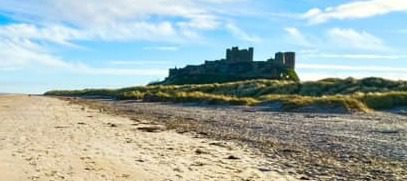
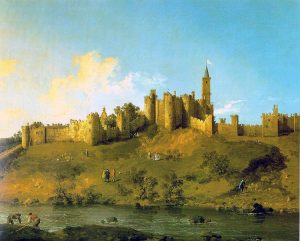
Following the Battle of Towton the defeated Lancastrians established a foothold in the North East. Based largely in Castles held by the Percy family, such as Alnwick, Bamburgh, and Dunstanburgh, they were able to hold out against Yorkist assaults until they were defeated in the Battle of Hexham, in May 1464. This suggests that the Lancastrian forces and those of their French and Scottish allies were, perhaps, considerable at times. Is this true?
Whilst the fortunes of both parties fluctuated in the North East between the Battles of Towton and Hexham, it is notable that the defeated Lancastrians were able to withstand sustained pressure from the new Yorkist regime for over three years. This despite the fact that Richard Neville 16th Earl of Warwick and his brother, John Neville, Lord Montagu, had ordnance and a sizeable force of men at their disposal.
This shows that the Lancastrians were able to bring men and supplies into the castles and region. This included support from Scotland and France. This was achieved via land and sea, with the latter being a sometimes perilous journey due to the weather, along with the presence of a Yorkist fleet in the North Sea.
Even with the strength of the defences in Northumberland’s castles, the sheer weight of numbers and force would make losing the sites inevitable at some stage. So, how large was the force supporting the Lancastrian enclave in the far North East of England?
Numbers from Chronicles
Chronicles give an indication as to the strength of forces that were dispatched to aid the Lancastrians in the North East. The problem though is that most of the Chroniclers were based in the south, far away from the scene of the reliefs. Therefore at best, the information is usually second hand. Furthermore, the chroniclers may have had reasons to exaggerate or understate the numbers involved. This would be to maximise or minimise the impression of success or failure of either side, dependant upon who, if either, the chronicler supported or was patronised by.
Some Chroniclers wrote long after the events as well resulting in them basing their accounts on the stories that they heard from those who were, or were not, there. These again are suspect as those invovled in any clash are not always the most reliable of sources: it is quite easy to overstate how well you and your companions did in any such clash.
John Hardyng [1376-1465]
Hardyng suggested that Queen Margaret brought a force of 4000 French with her when she returned from France with Pierre le Breze. Hardyng was writing this shortly after the event. He had close ties to the region, having served under the Percy family. John Hardyng was writing for King Edward IV at the time of his death. He had previously prepared a history of England for King Henry VI and had begun the work that includes the Lancastrian occupation of Percy strongholds for Richard 3rd Duke of York. Therefore he had local knowledge but was patronised by the Yorkists at the time of his writing.
William Gregory [1400-1467, or a continuation of his writing]
Gregory suggests that 400 French soldiers were captured on Holy Island.
His figure for the number of Scots supporting the Lancastrians at Norham Castle in 1463 is 24,000.
An ambush of 80 spearmen lay in wait for Lord Montagu as he went to Norham.
Jean de Waurin [1400-1474]
Jean de Waurin’s account says that 2000 French troops accompanied Margaret of Anjou and Pierre de Breze to the aid of the North Eastern Lancastrian enclave.
William of Worcester [1415-92]
Says that Margaret of Anjou returned to Scotland with Pierre de Breze and a force of 2000 men.
William of Worcester also states that John Neville, Lord Montagu had a Yorkist force of 4000 at Hexham.
Warkworth’s Chronicle [relevant section believed to have been added c1484]
And Sere Peris le Brasylle, knyght, of Fraunce, and the best warrer of alle that tyme, was in Scotlonde to helpe Quene Margaret ; when he knew that the castelles were besegede, he hade xx m^ of Scottesmenne, and came toward Alnwyke and alle the other castel
The Warkworth Chronicle states that Pierre de Breze brought 20,000 men with him from Scotland to relieve Alnwick. This would presumably include the French soldiers who had sailed with him and Queen Margaret.
For the Battle of Hexham the Warkworth Chronicle says that John Neville, Lord Montagu, had a Yorkist army of 10,000.
Robert Fabyan [1470-1513]
Like Hall, below, Fabyan states that 400 men were taken prisoner on Holy Island by the Yorkists.
A Short English Chronicle [Compiled by Stow]
The Short English Chronicle states that Queen Margaret ‘toke Bamburgh, Anwyke, and Donsynburgh with the nombre of vj Ml of Frensshemen‘. That is 6000 French soldiers.
Edward Hall (Published 1546)
Rather confusingly says that Margaret of Anjou had 500 men with her when she returned to Scotland. It then goes on to say that 500 of these men were killed and 400 taken prisoner. This illustrates just how unreliable Chronicles can be at times. If it is a crew of 500 across the fleet, plus soldiers, it is a possibility but Hall does not make that, or the source of his information, clear. In terms of consistency though, 400 being taken prisoner on Holy Island is one of the most cited as THe Chronicle of London also notes 400 and Gregory’s Chronicle is close, saying 406.
Grafton’s Chronicle [d 1573]
For the Battle of Hedgely Moor, Grafton’s Chronicle suggests a force of 5000 for the Lancastrian side.
Grafton’s Chronicle [Published 1569]
Grafton makes several mistakes in his chronicle. For example, he gets the chronology wrong at times, muddling the order of the relief of Alnwick and the Battle of Hexham. For the latter, he states that there were 13,000 Scots on the Lancastrian side at Hexham. This is incredibly unlikely and is at odds with what historians think: Heritage Gateway describes it as being ‘a small Lancastrian army’.
Annales of England [First published 1592]
Annales of England compiled by John Stow in the 16th century states that some 20,000 Yorkists were involved in the sieges of Alnwick, Bamburgh and Dunstanburgh in November of 1462. It also states that the defence of the three castles was undertaken by a combined force numbering 720 men.
What do the sources agree on?
Very little with respect of the numbers. The closest to consensus is on the number of French soldiers taken prisoner by the Yorkists on Holy Island. Otherwise, the numbers have quite a large range.
What the sources do agree on it the places, people involved, and usually the dates. In terms of the size of forces involved it is not possible to discern an accurate figure from the combination of sources. This is true of the Scottish relief forces, the size of the force that Queen Margaret brought from France, or the size of forces at either Hedgely Moor, or Hexham.
In short, other sources of evidence need to be sought out to gain a fuller understanding of the number of men involved in any of these relief operations, or battles.
Sources used
Annals of England. John Stow.
‘A Short English Chronicle: London under Edward IV (1461-83)‘, in Three Fifteenth-Century Chronicles with Historical Memoranda by John Stowe, ed. James Gairdner( London, 1880), British History Online
Robert Fabyan. [ed Henry Ellis]. The new chronicles of England and France, in two parts : by Robert Fabyan. Named by himself The concordance of histories. Reprinted from Pynson’s edition of 1516. The first part collated with the editions of 1533, 1542, and 1559; and the second with a manuscript of the author’s own time, as well as the subsequent editions: including the different continuations. To which are added a biographical and literary preface, and an index
Richard Grafton. Grafton’s chronicle : or, History of England. To which is added his table of the bailiffs, sherrifs, and mayors, of the city of London. From the year 1189 to 1558, inclusive.
‘Gregory’s Chronicle: 1461-1469‘, in The Historical Collections of a Citizen of London in the Fifteenth Century, ed. James Gairdner( London, 1876), British History Online
Edward Hall. Hall’s chronicle : containing the history of England, during the reign of Henry the Fourth, and the succeeding monarchs, to the end of the reign of Henry the Eighth.
John Hardyng, The Chronicle of John Hardyng
Warkworth’s Chronicle. A chronicle of the first thirteen years of the reign of King Edward the Fourth. Warkworth, John, d. 1500; University of Cambridge. Petershouse. Library. Mss (230); Halliwell-Phillipps, J. O. (James Orchard), 1820-1889
Jean de Waurin. A collection of the chronicles and ancient histories of Great Britain, now called England. Waurin, Jean.
Worcestre, William, ‘Annales Rerum Anglicarum’
Featured Image
Bamburgh Castle, Northumberland. Photo by Matt Brown