Ralph Cromwell 3rd Baron Cromwell was a soldier, administrator and wealthy landowner in the 15th century. After serving in Normandy, Ralph was appointed to important roles. He was treasurer of England from 1433 – 1443, after which he became involved in land disputes. One resulted in him being assaulted at Westminster by Sir William Tailboys. Others led to his involvement in the impeachment of William de la Pole Duke of Suffolk, and clashes with Henry Holland 3rd Duke of Exeter. By 1455 Ralph 3rd Baron Cromwell was aligned with the Duke of York. He was a day late for the First Battle of St. Albans, and died peacefully at one of his Derbyshire manors in January 1456.
Ralph Cromwell’s service in France
As a youth, Ralph Cromwell was placed into the household of Thomas Duke of Clarence. This led to him having military experience at a reasonably early age. In 1412, Ralph was among the retinue of the Duke which intervened in the clashes between the Dukes of Burgundy and Orléans. This was followed, in 1415, with his involvement in King Henry V’s campaigns into France. Ralph was present at the Siege of Harfleur, and fought in the Battle of Agincourt. In the follow up campaigns to assert control over Normandy, Ralph was involved in the capture of Caen [1417], before being appointed Lieutenant of several key garrisons.
In 1420 Ralph was one of the negotiators who brought about the Treaty of Troyes. Having assisted King Henry V in acquiring the right to succeed to the throne of France, he was then appointed as Captain of Harfleur, a key appointment in the administration of English controlled France.
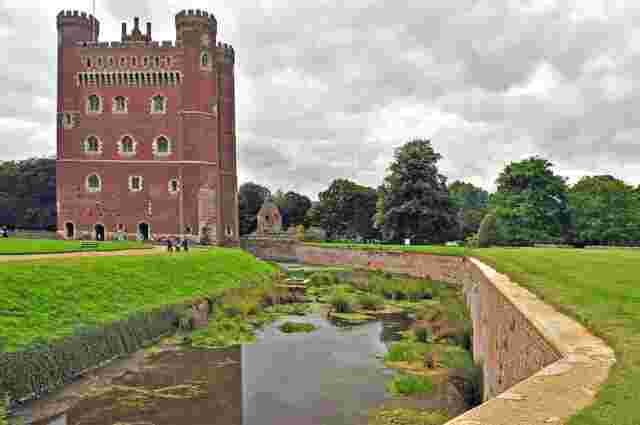
Tattershall Castle, Ralph Cromwell’s primary home
In 1419 Ralph Cromwell inherited the barony of Tattershall from his maternal grandmother. He set about transforming Tattershall Castle. The original, licenced in 1219, was replaced with a brick built castle. Like other castles redeveloped at this time, there was a mixture of military features with increased attention to style, comfort, and splendour. Tattershall Castle under Ralph Lord Cromwell was transformed from a relatively basic construction into one of England’s finest palatial castle constructions. It was a hugely expensive undertaking, with the site becoming double moated, having a new great tower, substantial lodgings for guests, and gardens.
The redeveloped Tattershall Castle was intended as a statement. It became a focal point for local gentry and enhanced Ralph Cromwell’s standing amongst his neighbours. It was funded not only through wealth inherited by himself and his wife but also through his expansion of his business and land interests which were often due to his position as Treasurer of England.

Treasurer of England
When King Henry V died in 1422, Ralph was summoned to parliament as 3rd Baron Cromwell. He was appointed as one of the members of the minority Council of King Henry VI. From this point onwards, Ralph’s work was based in England. By 1433 Ralph Cromwell had established himself at Court and in Council to the extent where he was appointed to the position of Treasurer of England. He was to hold the office for a long time, not resigning until 1443 [only one holder of this office served for longer in the medieval period]. His work on Council and as holder of an office of state drew him close in affinity to Cardinal Beaufort, with whom he worked closely on fiscal matters and the financing of England’s interests overseas.
Ralph Cromwell’s land disputes
In the late 1440’s, Ralph 3rd Baron Cromwell became embroiled in disputes with William Tailboys. This saw Tailboys assault Cromwell outside the Star Chamber. There followed Ralph’s involvement in the impeachment of Tailboy’s patron, the Duke of Suffolk, and ongoing legal actions against Sir William into the 1450’s. These land disputes were not isolated, Ralph 3rd Baron Cromwell also had disputes with Henry Holland 3rd Duke of Exeter.
Ralph Cromwell’s dispute with Sir William Tailboys was primarily over land rights. Tailboys was another member of the Lincolnshire gentry – though also Earl of Kyme. As with many other cases of disputes over lands at this time it turned violent. Sir William Tailboys became known for his aggressive approach to defending his rights or asserting his claims [see examples in our page listing regional violence in the 15th century]. The dispute is best known for a rather unusual incident though.
Ralph Cromwell was still a member of the Council. Though no longer Treasurer of England, he retained some influence at the highest level. He still attended meetings in Westminster. Cromwell was still very much one of the premier administrators of the realm. In this capacity, he attended meetings relating to matters of State held in the Star Chamber, and at Westminster. The heart of English government.
On 28 November 1449 Ralph 3rd Baron Cromwell was in Westminster for Parliament. He attended a Council meeting in the Star Chamber. Sir William Tailboys was also in Westminster as Parliament sat. He was angered by the land disputes. Rather than using the legal means that were quite literally around the corner from the Star Chamber, Sir William and a group of his associates waited for Lord Cromwell outside the Chamber in which the Council was meeting. As the meeting ended and lords made their exits, they attacked him. Ralph was accompanied by other men and was able to escape serious injury, but the intent was clear and the location one of huge importance.
Sir William’s assault, perhaps attempted murder, of Ralph Cromwell, had implications for other men. Tailboys was aligned to the unpopular William de la Pole, Duke of Suffolk. The Duke’s rise had very much coincided with the seemingly forced resignation of Lord Cromwell from the position of Treasurer in 1443. Now, Cromwell had added motive to be rid of a senior political foe. And so, it seems, that Ralph Cromwell set about providing detailed information which would soon result in the impeachment of William de la Pole, who was subsequently ordered into exile, then assassinated.
A reluctant Yorkist?
Further disputes over estates then followed. Henry Holland 3rd Duke of Exeter began staking a claim to lands. This led to violence, by the Duke, in 1452 and 1453. Ralph had also been suspended from Council in 1452 under suspicion of having supported the Duke of York in the build up to the Standoff at Dartford. As tension around his lands mounted, Cromwell became attached to the Neville family through marriage: a niece, who was his co-heiress, married Sir Thomas Neville in 1453. Bound by shared political foes, land interests, and familial affinity, Ralph Lord Cromwell turned towards the emerging Yorkist faction.
His enthusiasm for the Yorkist cause can be questioned. As the Yorkist lords determined to make a stand against their foes in 1455, Ralph was slow to join them. Indeed, as the Duke of York, Earl of Warwick, and Earl of Salisbury converged on St. Albans in 1455, Ralph Cromwell, remained a days ride away. He entered St. Albans the day after the first battle of the Wars of the Roses, despite being quite aware of the locations of both parties.
Death of Ralph Cromwell 3rd Baron Cromwell
Ralph 3rd Baron Cromwell died whilst at one of his Derbyshire Manors on 4 January 1456.
Ralph Cromwell 3rd Baron Cromwell Links
Oxford Dictionary of National Biography – Cromwell, Ralph, third Baron Cromwell
Society for Lincolnshire History and Archeaology – Ralph Cromwell, Treasurer of England.
Lambley Heritage – A few facts and personal observations on Sir Ralph de Cromwell (1393-1456), Treasurer of England. PDF File.
The History Jar – Ralph Cromwell, Lord Treasurer…Mr Moneybags
UEA. The Wymondham Market Charter of 1440 and Ralph, Lord Cromwell. J. R. Alban. Thesis.
Featured Image
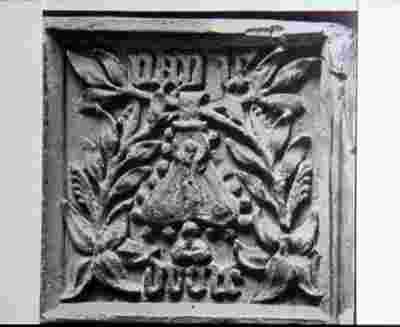
Badge of Ralph 3rd Baron Cromwell, Lord High Treasurer above the fireplace at Tattershall Castle. Via The Heraldry Society