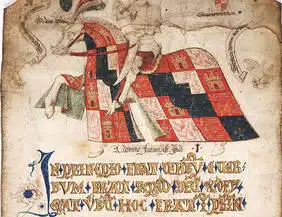
On 4 March 1461 the Yorkists proclaimed that Edward, by now Duke of York, was King of England. The proclamation took place in London. It occurred whilst King Henry VI was alive, and without Parliament being in session. Justifications for the declaration included the failure of King Henry VI to adhere to the terms of the Act of Accord, the right of inheritance by lineage of Edward as agreed by Parliament in 1460, and the failings of the Lancastrian government. The announcement was accompanied by much rumour, including ones that Henry VI had abdicated, and that he had taken poison given to him by Queen Margaret.
Sources: The Proclamation of Edward IV as King on 4 March 1461
Milan State Papers
70. Nicolo Darabatta to Francesco Copino, bishop of Terni, Papal Legate to England and Flanders.
On the 23rd ult. I wrote to your lordship. They say here that you suffered great travail at sea and the ship was driven to Holland and considered as lost, but by the grace of God you escaped safe, which has caused me great joy.
By my last letter I advised your lordship of the news here and told you how at St. Albans on carnival day the forces of the queen and prince routed those of the king and Warwick, with a great slaughter, and that every one believed that Warwick had gone to Calais. But it was not so, as he went to meet the Earl of March, and last Friday after dinner they came here with about 5,000 persons, including foot and horse. A great crowd flocked together and with the lords, who were there, they chose the Earl of March as their king and sovereign lord, and that day they celebrated the solemnity, going in procession through the place amid great festivities. It remains to see how King Henry, his son, the queen and the other lords will bear this, as it is said that the new king will shortly leave here to go after them. As I said above there is a great multitude, who say they want to be with him to live and die (che come dico disopra qui si trova grande populo che dicono volere essere con lui ad vincir et morire). These are great matters sufficient to fill every man with fear, and would to God I had not come with your lordship, when I should not have found myself amid these disturbances. Possibly I may be able to cross shortly, as a ship is being prepared in which some nobles are going, from what I can gather. While I am here I will send daily advices of what happens.
London, the 4th March, 1460.
[Italian; copy.]‘Milan: 1461’, in Calendar of State Papers and Manuscripts in the Archives and Collections of Milan 1385-1618, ed. Allen B Hinds (London, 1912), British History Online
Croyland Chronicle
Accordingly, the nobles of the realm, and all the people who inhabited the midland counties of England, as well as those who were situate in the eastern and western parts thereof, or in any way bordered upon the midland districts, seeing that they were despised and abandoned by king Henry, who, at the instigation of the queen, had betaken himself to the north, utterly forsook him, after he had completed a reign o£ thirty-nine years; and their hearts were now no longer with him, nor would they any longer admit of his being king. Besides, in consequence of a malady that had been for many years increasing upon him, he had fallen into a weak state of mind, and had for a length of time remained in a state of imbecility and held the government of the realm in name only. Upon this, the nobles and people immediately sent special messengers into Wales to the before named earl of March, in whom they could place entire confidence, to disclose to him the wishes of the people, and request him, with earnest entreaties, to hasten into England to their speedy succour, as further delay only seemed to increase their perils.
Accordingly, in the year of our Lord, 1461, at the beginning of March, the before-named earl of March arrived in England, having enjoyed a prosperous voyage, the west wind favouring his passage. Here he was immediately received with unbounded joy by the clergy and all the people, and especially by the citizens of London ; and, after a short time. Parliament being assembled, amid the acclamations of all he was made king of England. However, he would not at present allow himself to be crowned, but immediately, like unto Gideon or another of the judges, acting faithfully in the Lord, girded himself with the sword of battle ; and prosperously hastened his steps, being met by bands of warriors innumerable, to avenge the injuries of the Church and the realm. Por, as we have already stated, he was then of vigorous age, and well fitted to endure the conflict of battle, while, at the same time, he was fully equal to the management of the affairs of the state.
Ingulph’s chronicle of the abbey of Croyland with the continuations by Peter of Blois and anonymous writers. ed Riley, H. (London : G. Bell & sons, 1908). Archive.org
Gregory’s Chronicle
Alle soo the xxvj day of Februer nexte folowyng Edwarde Erle of Marche com to London owt of Walys and the Erle of Warwycke with hym, and xl Mlmen with hem bothe, and they enteryd unto the cytte of London, and there he toke uppon hym the crowne of Inglond by the avysse of the lordys spyrytual and temporalle, and by the elexyon of the comyns. And so he be-gan hys rayne the iiij day of Marche, in the yere of oure Lorde God MlCCCC lxj, the Sondy letter D as for that yere.
Thys ys the fyrste of hys rayne of Kynge Edwarde the iiijthe.
‘Gregory’s Chronicle: 1461-1469’, in The Historical Collections of a Citizen of London in the Fifteenth Century, ed. James Gairdner (London, 1876), British History Online
A Short English Chronicle
And a none forthe with he made him redy a gayne in the marche of Walis, and on the Thorsday the first weke of Lenten he came to London with xxx ml men of Westren men and Walsshmen, Kentes men and Esex men togeders, and so in feld and towne everychone called Edward Kynge of Ingelond and of Fraunce. And the iiijth day of Marche he rode to Westmester and resseyved the septor with his dignite.
A Short English Chronicle: London under Henry VI (1422-71)’, in Three Fifteenth-Century Chronicles with Historical Memoranda by John Stowe, ed. James Gairdner (London, 1880), British History Online
Related Content
Justifications of the proclamation of Edward IV as King of England
Kingship: Legitimacy and Right
Richard Neville 16th Earl of Warwick ‘The Kingmaker’
Featured Image
Illustration from the top of Edward IV’s Coronation Roll