Antonio de Turi [see note at foot of page] was a diplomat. As England descended into chaos, he wrote to his masters on the Continent to try and elicit diplomatic changes which would improve the lot of his English associates. Below is one such letter, dated 24 January 1461 to the Duke of Milan. The envoy was not only quite blunt in his assessment, noting had action been taken that,“all this ruin would not have happened”. He is also persistent in his pleading for intervention, this being one of two letters to the Duke of Milan that he penned on this date: the other letter is found here.
The main argument in the envoys correspondence matches a theme that is evident in letters to the Duke of Milan from the Papal Legate Fransceco Coppini, and in the commincations from Richard Neville 16th Earl of Warwick. Each asks for the advancement of Francesco Coppini. To the Duke of Milan, they ask for pressure to be applied on the Pope ‘for the advancement of the legate’ and to the Pope in other letters they argue for the same.

The motive for wanting the promotion of the Papal Legate is clear. Papal approval is of importance, not only to the church authorities in England, but also to individual bishops, priests, and to the laity. Should Copini be promoted, his words carry more authority. This is of significance politically in the immediate sense as it could impact on ecclesiastical support for one faction over the other. It is also of relevance in the medium term, as the blessing of the Pope and/or his emissaries influences the public perception of the legitimacy of a cause, or of a Kingship.
59. Antonio de Turi, English Envoy to the Papal Court, etc. to Francesco Sforza, Duke of Milan.
If the Holy Father had given heed to the desire of the king and these lords, set forth by me, all this ruin would not have happened, as monsignor the legate would have been able to make good by his reputation, which alone had sufficed for the affairs here, where our opponents have published the contrary. Our friends, who have seen the pope take so little account of affairs here, less than they expected, have grown cold and have half lost their opinion of the legate. This coolness of the Court spoils such a fine design; accordingly your Lordship should solicit the Court for the advancement of the legate, especially as the king and the other lords request it with such urgency and for such honourable and necessary reasons. If help does not come, the Earl of Warwick sees no remedy, and before Easter will be ruined the whole of that great and fine design devised for the honour of God and the estate of the Church and of your Excellency, to whom I recommend myself humbly (unde e di bisogno che Vestra Ex. solicita in Corte per la exaltatione de dicto Mons. el legato et maxime domandola la Maesta del Re et li altri Signori con tanta instantia et per si honeste et necessarie casone: altramente se non se aiuta lo Illustrissimo Conte di Varuich non vede remedio ch’avanti sia pasca sera guasto tucto el desegno grande et bello che ordinato per honore di dio et del stato de la chiesa et de Vestra Ex. a la quale mi recommando devotissime).
[Italian.]
Note: Antonio’s name has various spellings in the Milan State Papers. In the above, it is spelt as Turi. Elsewhere it most commonly spelt Antonio de la Torre.
Featured Image
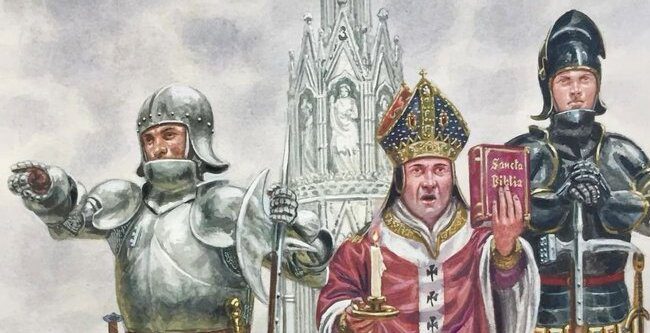
Seen, uncredited, on Twitter/X. Captioned as showing Francesco Coppini alongside Yorkist Lords.
Further Reading
The Battle of Wakefield page includes recent research along with the traditional account. The Battle of Towton page contains a range of source material outlining the changing narrative over time. The Milanese papers are extensive, with a selection of relevant documents indexed here. An overview of the traditional narrative of the Battle of Wakefield, or the Battle of Towton, with notes on more recent thinking. For recent research and academic commentary about this period, see the Substack posts by Dr. David Grummitt.